How to Read a Supplement Label: 7 Checks That Matter

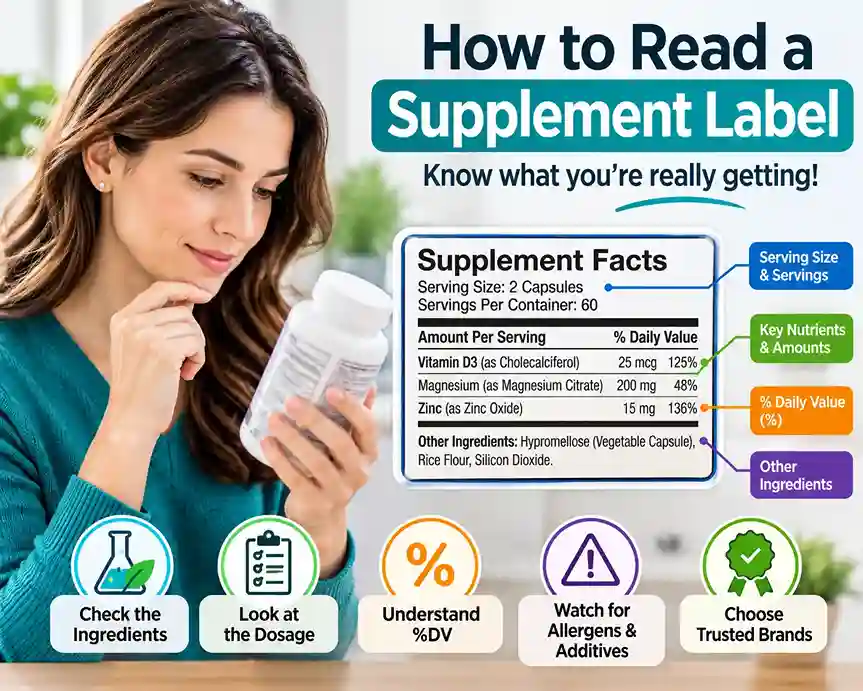
Learning how to read a supplement label takes about a minute once you know where to look. Check the serving size, check whether the active ingredients are hidden inside a proprietary blend, and check for a third-party seal. Those three checks rule out most of what is not worth buying — and the label tells you more than most people realise.
Why the label is all you have
In the United States, the FDA does not approve dietary supplements before they go on sale. There is no pre-market check that a product works, and no pre-market check that the bottle contains what the label says. Manufacturers are responsible for their own claims. That makes the label the primary document you have to work from — and it is written by the company selling you the product.
The good news is that the format is standardised. Once you know how to read a supplement label, comparing two products takes seconds.
1. Serving size: the number everything depends on
Serving size sits at the top of the Supplement Facts panel, and every figure below it refers to that serving — not to one capsule.
If the serving size is three capsules and the panel lists 500mg of an ingredient, you get 500mg only when you take all three. A bottle of 90 capsules at three per serving is a 30-day supply, not 90 days. This is the single most common way a product looks cheaper and stronger than it is. Always check “Servings Per Container” before comparing prices.
2. Amount per serving, and % Daily Value
Next to each ingredient you will see an amount and, sometimes, a percentage. The percentage is the % Daily Value — how much of the officially established daily requirement one serving provides.
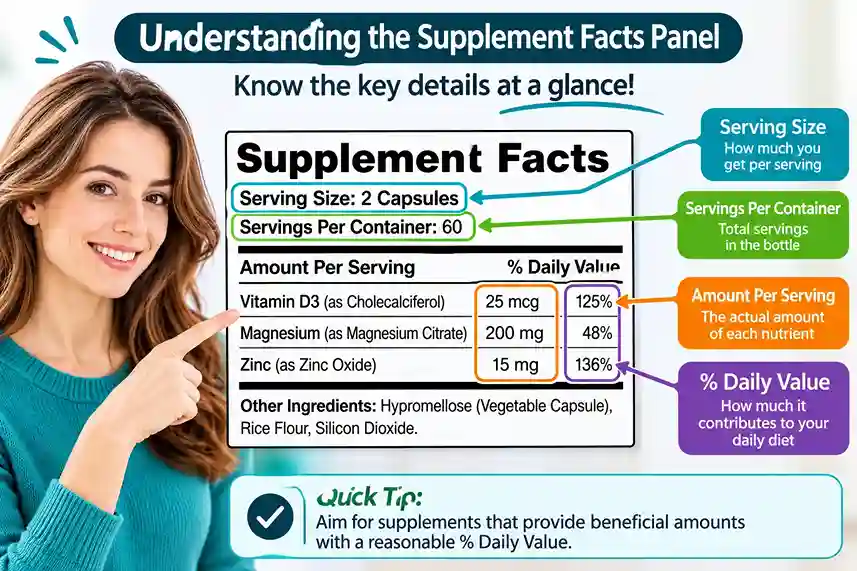
Many supplement ingredients have no established Daily Value at all. Herbs, botanicals, probiotics, amino acids and compounds like CoQ10 typically show a dagger symbol and a footnote reading “Daily Value not established”. That is not a warning sign. It simply means no official reference intake exists, so the percentage column cannot be filled in.
What matters far more is whether the amount present matches the amount used in research. A product can contain a genuinely useful ingredient at a dose too small to do anything — a practice known in the industry as fairy dusting, where an ingredient appears on the label for marketing purposes at a fraction of the studied dose.
3. Proprietary blends: the biggest blind spot on any label
A proprietary blend is a group of ingredients sold under one name — often styled as a “blend”, “complex”, “matrix” or “formula”. Under US law, the manufacturer must declare the total weight of the blend and list everything in it, but does not have to tell you how much of each ingredient is present. The ingredients are listed in descending order by weight, and that is all you get.
Consider a 500mg “Sleep Support Matrix” containing magnesium, L-theanine, valerian and melatonin. That could be 480mg of magnesium and a trace of everything else. It could be the reverse. The label is legally complete either way, and you cannot tell.
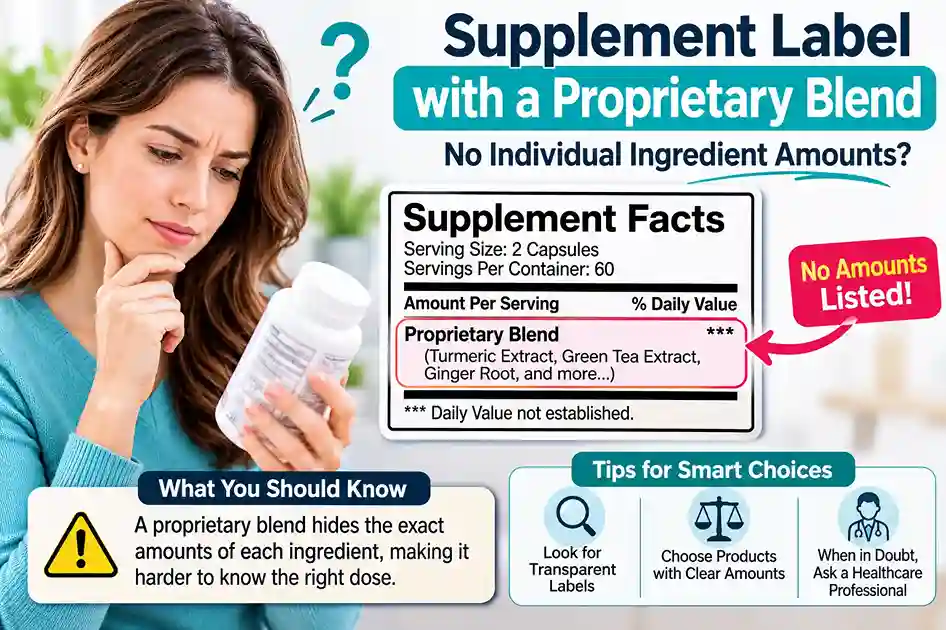
This matters for two reasons. You cannot compare the product against published research, because you do not know the doses. And you cannot judge safety — which becomes serious when a blend contains stimulants, where the difference between a modest and an excessive amount of caffeine is not academic.
A proprietary blend does not automatically mean a bad product. But a company confident in its formula usually has no reason to hide the numbers, and plenty of good manufacturers publish them in full.
4. Other Ingredients
Below the Supplement Facts panel sits a line reading “Other Ingredients”. These are the parts that are not active: capsule material, binders, flow agents, fillers, colourings.
Usually unremarkable, occasionally the deciding factor. This is where you will find gelatin if you need a vegetarian capsule, and where common allergens appear — soy, dairy, wheat, shellfish-derived ingredients. If you react to something, this is the line to read first.
5. What the label is legally allowed to claim
Supplements may make what are called structure/function claims — statements about supporting normal body function. “Supports immune health” and “helps maintain healthy joints” are permitted. What they may not claim is to treat, cure or prevent disease, because that would make the product a drug.
This is why labels carry the familiar small print stating that the FDA has not evaluated the statement and that the product is not intended to diagnose, treat, cure or prevent any disease. That disclaimer is legally required whenever a structure/function claim is made. It is worth reading as what it is: a notice that nobody has checked whether the claim on the front of the bottle is true.
One phrase that should always give you pause is “pharmaceutical strength”. An over-the-counter supplement cannot legally match a drug’s strength — at that point it would be regulated as a drug.
6. Third-party seals: which ones mean something
Because no government body verifies supplements before sale, independent testing is the most meaningful quality signal available. Several programmes exist and they test different things.
- USP Verified — confirms the product contains what the label says, in the stated amounts, and was made in a controlled facility.
- NSF Certified for Sport — tests every lot against roughly 280 substances banned in competitive sport, on top of standard contents verification. Note that a plain NSF mark is not the same certification; look for the full “Certified for Sport” wording.
- Informed Sport — tests every batch before release.
- Informed Choice — similar branding, weaker guarantee: periodic sampling from the open market rather than batch-by-batch testing.
All of these are voluntary programmes that manufacturers pay to join, so their absence does not prove a product is poor — many small, reputable brands cannot justify the cost. What a seal does tell you is that somebody outside the company has looked.
One thing a seal does not tell you: whether the supplement works. Verification is about identity, potency and purity, not efficacy. A USP-verified product can be a verified dose of something with no evidence behind it.
7. The form of an ingredient matters as much as the amount
“Magnesium 400mg” tells you less than it appears to. Magnesium oxide, citrate and glycinate are absorbed differently and tolerated differently. The same applies across the board: folate versus folic acid, different forms of vitamin E, different curcumin preparations.
A label that specifies the exact form is being more useful than one that does not — and a label that names only the mineral, with no form given, is worth a second look.
How to read a supplement label in one minute
- How many capsules make one serving, and how many servings are in the bottle?
- Are the active ingredients listed with individual amounts, or hidden in a blend?
- Do those amounts match what research actually used?
- Is the specific form of each ingredient named?
- Does Other Ingredients contain anything you react to?
- Is there a third-party seal, and is it the real one?
If a product fails on points two and three, nothing else on the label can rescue it.
Where to check further
The NIH Office of Dietary Supplements publishes plain-language fact sheets on individual nutrients, including typical doses and known interactions. The FDA’s Dietary Supplement Labeling Guide sets out exactly what manufacturers must and must not put on a label.
And if you are unsure whether a supplement is appropriate alongside medication you already take, that is a question for a pharmacist — they will answer it free, and they are very good at it.
Frequently asked questions
What does 'Daily Value not established' mean on a supplement label?
It means no official daily reference intake exists for that ingredient, which is normal for herbs, botanicals, probiotics and many amino acids. It is not a warning. Judge the ingredient by whether its amount matches the doses used in research instead.
Are proprietary blends bad?
Not automatically, but they hide the dose of each ingredient, so you cannot compare the product against published research or judge safety properly. A manufacturer confident in its formula usually has no reason to withhold the numbers.
Does a USP or NSF seal mean a supplement works?
No. Those programmes verify that a product contains what the label says, in the stated amounts, without harmful contaminants. They say nothing about whether the ingredient is effective.
Why do supplement labels say the FDA has not evaluated the statement?
US law requires that disclaimer whenever a product makes a structure/function claim, such as supporting immune health. Supplements are not reviewed or approved by the FDA before sale.
