
Magnesium Glycinate for Sleep: What 3 Trials Actually Found


Magnesium glycinate for sleep is the most heavily marketed supplement on the shelf, and the honest summary is this: the evidence that magnesium helps sleep is weak, and the evidence for glycinate specifically is almost nonexistent — because the trials used other forms. It may still be worth trying. Here is what the research actually found, so you can decide with your eyes open.
What magnesium does, and why sleep is plausible
Magnesium is an essential mineral involved in hundreds of enzymatic reactions. Relevant to sleep, it plays a role in nerve signalling and in the regulation of GABA, the main calming neurotransmitter in the brain.
So the mechanism is plausible, which is why the idea took hold. Plausible is not the same as proven, and this is where most articles on the subject stop being useful.
What the trials actually found
The most cited evidence is a 2021 systematic review and meta-analysis of oral magnesium for insomnia in older adults. It pooled three randomised controlled trials, totalling 151 people.
The result: people taking magnesium fell asleep about 17 minutes faster than those on placebo, and that difference was statistically significant. Total sleep time improved by roughly 16 minutes, but that figure was not statistically significant — meaning it could reasonably be chance.
Now the part the supplement adverts leave out. All three trials were judged to be at moderate-to-high risk of bias, and the reviewers graded the overall quality of evidence as low to very low. Their own conclusion was that the evidence is substandard for physicians to make well-informed recommendations about oral magnesium.
A more recent systematic review covering adults generally reached a similar place: findings inconsistent, certainty low, and several placebo-controlled trials showing no clear benefit for overall sleep quality at all.
Observational studies do show that people with higher magnesium intake tend to sleep better. But people who eat more magnesium-rich food tend to eat better generally, exercise more and differ in a dozen other ways. That kind of study cannot separate the mineral from the lifestyle.
The glycinate problem
Here is the detail that matters most, and the one almost nobody mentions.
The trials above did not use magnesium glycinate. They used other forms. The case for glycinate specifically rests on two reasonable arguments — that it is well absorbed, and that glycine itself has some evidence for improving sleep — but not on trials testing magnesium glycinate for sleep against placebo.
That does not mean it does not work. It means that when a label says “clinically studied for sleep”, the clinical study was probably of a different compound at a different dose. Worth knowing before paying a premium for the form.
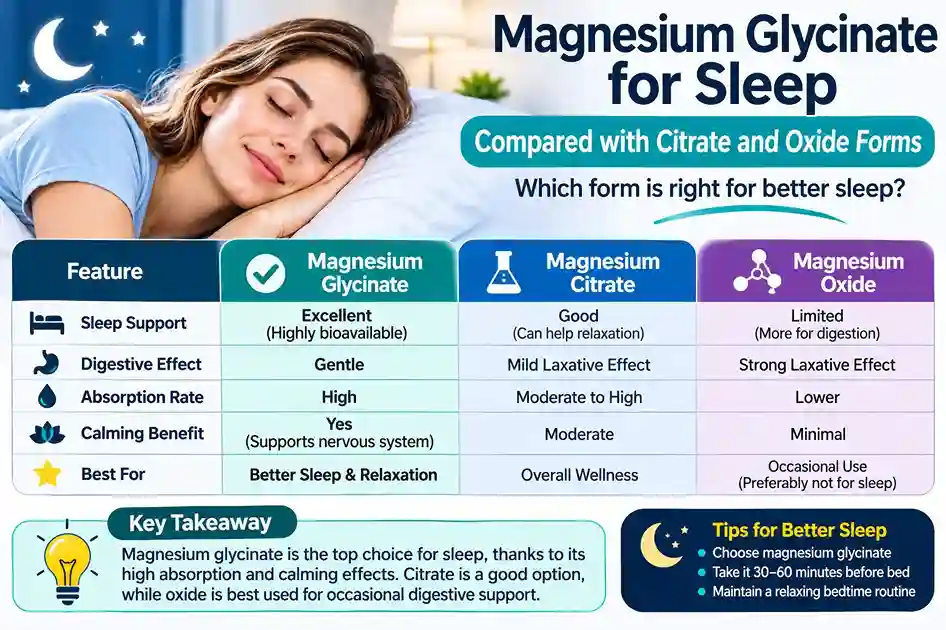
How the forms actually differ
Magnesium supplements are magnesium bound to something else, and the something else changes absorption and tolerability.
| Form | Absorption | Typically used for |
|---|---|---|
| Glycinate (bisglycinate) | Good | Daily use; gentle on the gut |
| Citrate | Good | Constipation; general supplementation |
| Oxide | Poor — around 4% | Cheap bulk dosing; short-term bowel relief |
| L-threonate | Good | Marketed for cognition; limited data |
The practical takeaway is about oxide. In a randomised comparison at 300mg of elemental magnesium, organic forms were absorbed significantly better than oxide, and oxide performed no differently from placebo on the measure used. Magnesium oxide is the form in most supermarket magnesium, because it is cheap and packs more elemental magnesium per tablet. It is also the form your body is least able to use.
Between glycinate and citrate, there is remarkably little direct human comparison. Glycinate is gentler on the digestive system; citrate is more likely to loosen your bowels, which some people want and others very much do not.
Who should consider magnesium glycinate for sleep
The strongest case is for people who are genuinely low in magnesium. Correcting a deficiency can improve sleep, fatigue and muscle cramps — but that is treating a deficiency, not a supplement having a sleep effect in its own right.
Risk factors for low magnesium include a diet low in leafy greens, nuts, legumes and whole grains; type 2 diabetes; long-term use of proton pump inhibitors or certain diuretics; heavy alcohol use; and older age.
If you eat reasonably well and sleep badly, magnesium is a long shot. Sleep timing, light exposure, caffeine and alcohol all have considerably better evidence behind them than any supplement.
Dose and timing
Trials of magnesium for sleep have generally used 250–500mg of elemental magnesium, taken in the evening.
Read the label carefully, because “1000mg magnesium glycinate” is not 1000mg of magnesium. The glycine makes up most of that weight. A product providing 1000mg of magnesium glycinate typically delivers around 100–140mg of elemental magnesium. The number that matters is the one marked elemental, and if the label does not state it, that itself tells you something — see our guide on how to read a supplement label.
Safety, side effects and interactions
Magnesium from supplements has a tolerable upper intake level of 350mg per day for adults, set by the US Institute of Medicine. That limit applies to supplemental magnesium only, not to magnesium from food, which healthy kidneys handle without difficulty.
The most common side effect of exceeding it is diarrhoea, and it arrives reliably.
Talk to a doctor first if you:
- have kidney disease — impaired kidneys cannot clear excess magnesium, and accumulation can become dangerous
- take bisphosphonates for osteoporosis, or certain antibiotics such as tetracyclines and quinolones — magnesium interferes with absorption, so doses need spacing by several hours
- take diuretics or proton pump inhibitors, which affect magnesium levels in both directions
- are pregnant or breastfeeding
The bottom line
Magnesium is cheap, widely available and low-risk at sensible doses, which is a genuinely reasonable basis for a personal trial. What it is not is a proven sleep aid, and the specific form sold hardest for sleep is the one with the least direct evidence behind it.
If you try it: pick glycinate or citrate over oxide, look for the elemental magnesium figure, start around 200mg in the evening, and give it two to three weeks. If nothing changes, it is not working for you — and no amount of marketing should persuade you otherwise.
Sources
- Mah & Pitre, Oral magnesium supplementation for insomnia in older adults: a systematic review and meta-analysis (BMC Complementary Medicine and Therapies, 2021)
- Walker et al., Mg citrate found more bioavailable than other Mg preparations (Magnesium Research, 2003)
- NIH Office of Dietary Supplements — Magnesium fact sheet
Frequently asked questions
Does magnesium glycinate actually help you sleep?
The evidence is weak. A meta-analysis of three small trials found people fell asleep about 17 minutes faster than on placebo, but the trials were at high risk of bias and the evidence was rated low to very low quality. None of them used glycinate specifically.
How much magnesium glycinate should I take for sleep?
Trials have used 250–500mg of elemental magnesium in the evening. Note that elemental magnesium is a fraction of the stated glycinate weight — 1000mg of magnesium glycinate typically provides around 100–140mg of actual magnesium.
Is magnesium glycinate better than citrate for sleep?
There is very little direct human research comparing them. Glycinate is gentler on the digestive system; citrate is more likely to have a laxative effect. Both are absorbed far better than magnesium oxide.
Can you take too much magnesium?
Yes. The upper limit for supplemental magnesium is 350mg a day for adults. Above that, diarrhoea is common. People with kidney disease should not supplement magnesium without medical advice, as impaired kidneys cannot clear the excess.