Do Collagen Supplements Work? What 23 Trials Found


Do collagen supplements work for skin? The meta-analyses say yes — until you separate them by who paid for them. Trials funded by supplement companies found benefits; independent trials found none. The honest answer is that this remains genuinely contested, and here is the evidence on both sides.
What collagen supplements are
Collagen is the structural protein that gives skin its firmness. Production declines from the mid-twenties onward, which is the biological fact every advert is built on.
Supplements contain hydrolysed collagen — collagen broken into short chains called peptides. The old objection was that eating collagen cannot help your skin because digestion reduces it to amino acids like any other protein. That turns out to be too simple: specific di- and tri-peptides, particularly one called Pro-Hyp, do survive digestion and appear in the bloodstream.
So the mechanism is not impossible. The question is whether it produces a visible difference on a real face.
What the trials found
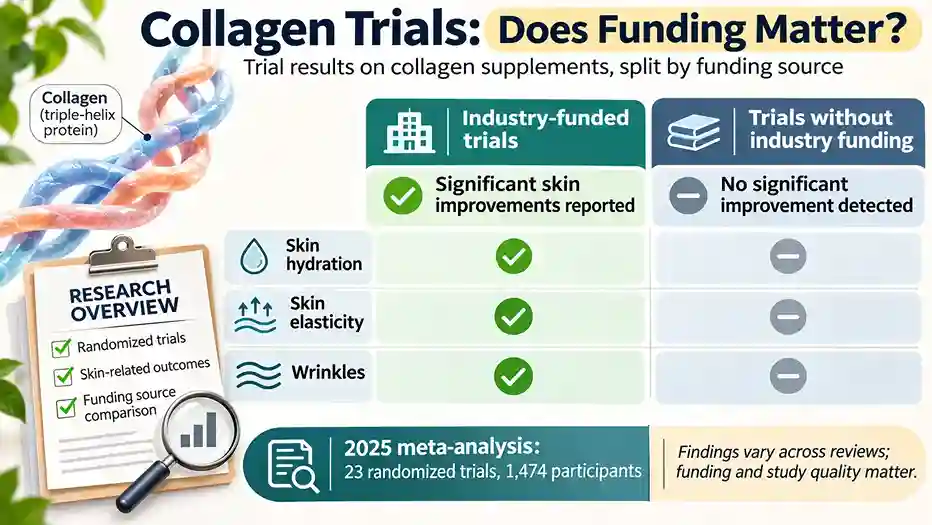
There is no shortage of research. A 2025 meta-analysis in the American Journal of Medicine pooled 23 randomised controlled trials across 1,474 participants, and the headline result was positive: significant improvements in skin hydration, elasticity and wrinkles.
A 2026 meta-analysis reached a similar conclusion, finding hydration and skin barrier function improved most reliably, with elasticity benefits appearing around the 12-week mark.
Taken at face value, that looks like a settled case.
Then you look at who paid
The same 2025 meta-analysis did something most do not: it split the trials by funding source.
Trials funded by pharmaceutical or supplement companies showed significant benefits. Trials without that funding showed no effect on hydration, elasticity or wrinkles.
The authors ran a second split, by study quality, and found the same pattern. Higher-quality studies showed no significant effect in any category. The improvements were concentrated in the lower-quality ones.
A separate appraisal in the Journal of Cosmetic Dermatology, by a biostatistician and a dermatologist, described the evidence base as methodologically fragile and prone to bias, noting that an overwhelming proportion of the underlying studies were industry-funded or written by authors with commercial ties to collagen manufacturers. Their conclusion was that promoting collagen as a validated anti-ageing intervention is premature.
The case for the other side
It would be unfair to stop there, because the funding critique has been challenged on reasonable grounds.
Industry bodies argued that the classification of which trials counted as “industry-funded” was inconsistent, and that industry funding does not automatically mean poor methodology — a fair point in principle, since most nutrition research is funded by someone with an interest in the answer.
More significantly, a separate and larger review analysed 16 systematic reviews and 113 randomised trials covering nearly 8,000 participants, and found consistent evidence that collagen improves skin elasticity and hydration over time. That review states it received no industry funding.
So we have a large independent review finding benefit, and a careful meta-analysis finding the benefit disappears in independent trials. Both cannot be fully right, and the disagreement has not been resolved.
Where that leaves you
A reasonable reading of all of it:
- Skin hydration has the most consistent support across reviews, and is the outcome most often improved.
- Elasticity shows benefit in several reviews, typically after about 12 weeks.
- Wrinkle reduction is the weakest claim and the one most dependent on who funded the study.
- Effects, where present, are modest — measurable with instruments, not dramatic in the mirror.
Nobody in this debate is claiming collagen does something large and obvious. The argument is about whether a small measurable effect is real.
Dose, form and timing
Trials have used anywhere from 1.5g to 10g daily, with 2.5g to 5g most common and around 4g the most frequently studied dose.
On source: bovine, marine and chicken collagen all appear in trials. Marine collagen is sometimes claimed to absorb better; the comparative evidence is thin. Choose based on dietary requirements rather than marketing.
On type: Type I and III dominate skin research, Type II is used for joint studies. A product listing its types is being more informative than one that does not — see how to read a supplement label for what else to check.
Give it 8 to 12 weeks. Every trial showing an effect ran at least that long, so judging it after a fortnight tells you nothing.
Things with stronger evidence than collagen
If the goal is skin that ages well, these have considerably more support and cost less:
- Daily broad-spectrum sunscreen — the single best-evidenced anti-ageing intervention there is
- Topical retinoids — decades of evidence for fine lines and skin texture
- Not smoking, and sleeping properly
- Adequate total protein — collagen is a protein, and most collagen powders are simply protein with a premium attached
That last point is worth sitting with. A 10g serving of collagen peptides is 10g of a low-quality protein, nutritionally speaking. If your overall protein intake is low, that is the gap worth closing first.
Safety
Collagen peptides are well tolerated. Reported side effects are mild and digestive — fullness, mild nausea, occasionally a lingering taste.
Points worth knowing: marine collagen is unsuitable if you have a fish or shellfish allergy; collagen is an animal product, so no supplement is vegan whatever the packaging implies; and as with any unregulated supplement, third-party testing matters, particularly for marine sources where heavy metal accumulation is a legitimate concern.
The bottom line
Do collagen supplements work? Possibly, modestly, for skin hydration and elasticity — and the strength of that “possibly” depends heavily on which analysis you trust.
What can be said without hedging is that the evidence is weaker than the marketing, the largest effects appear in trials paid for by people selling collagen, and nothing here supports the transformation implied by the advertising.
If you want to try it: 2.5–5g daily, for at least three months, from a third-party tested product, with realistic expectations. And wear sunscreen, which will do more for your skin than any powder.
Sources
- Myung & Park, Effects of Collagen Supplements on Skin Aging: A Systematic Review and Meta-Analysis (American Journal of Medicine, 2025)
- Oral Collagen Peptides and Skin Rejuvenation: An Updated Meta-Analysis (Journal of Cosmetic Dermatology, 2026)
- Effects of hydrolyzed collagen supplementation on skin aging: systematic review and meta-analysis
Frequently asked questions
Do collagen supplements work for wrinkles?
Wrinkle reduction is the weakest of collagen’s claims. A 2025 meta-analysis of 23 trials found benefits overall, but no effect in trials without supplement-industry funding, and no effect when only higher-quality studies were analysed.
How much collagen should I take daily?
Trials have used 1.5g to 10g, with 2.5–5g most common and around 4g the most frequently studied. Allow 8 to 12 weeks before judging the result — every trial showing an effect ran at least that long.
Is marine collagen better than bovine?
There is little direct comparative evidence. Marine collagen is sometimes claimed to absorb better, but the data are thin. Choose based on dietary needs and allergies — marine collagen is unsuitable with a fish or shellfish allergy.
Does collagen get destroyed by digestion?
Not entirely. Hydrolysed collagen is broken into short peptides, and specific di- and tri-peptides such as Pro-Hyp do reach the bloodstream intact. The mechanism is plausible; the question is whether the effect is visible.