Brain Health Supplements: What 2 Landmark Trials Found

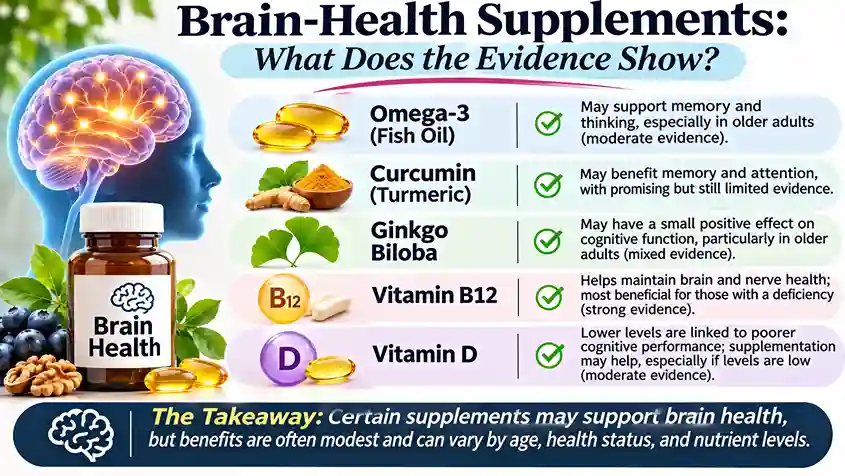
Brain health supplements have been tested at a scale most categories never reach. Two landmark trials — one of ginkgo biloba in over 3,000 older adults across six years, one of omega-3 in around 4,000 people across five — both came back negative. Neither reduced dementia, and neither slowed cognitive decline.
Ginkgo biloba: the trial designed to settle it
The Ginkgo Evaluation of Memory study was built to answer the question properly. It was the largest and first adequately powered randomised trial of ginkgo for dementia incidence, and its power calculations were set to detect a 30% reduction in dementia risk.
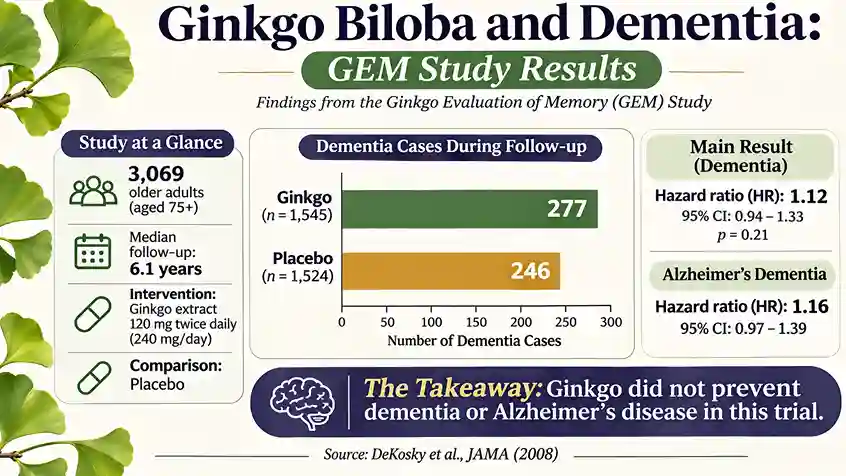
The design was as strong as prevention research gets: 3,069 participants randomised double-blind to 240 mg of ginkgo daily or placebo, followed for a median of 6.1 years, with dementia diagnoses adjudicated by neurologists and a dropout rate of only 6.3%.
523 participants developed dementia — 277 on ginkgo and 246 on placebo. The dementia rate was 3.3 per 100 person-years on ginkgo against 2.9 on placebo. The hazard ratio for all-cause dementia was 1.12 (95% CI 0.94–1.33) and for Alzheimer’s disease 1.16 (0.97–1.39). Neither was statistically significant.
Read the direction of those numbers carefully. The point estimate sits above 1.0, meaning slightly more dementia in the ginkgo group — not a significant difference, and not evidence of harm, but emphatically not the 30% reduction the trial was powered to find. A companion analysis found ginkgo also had no effect on the rate of cognitive decline. The authors concluded it cannot be recommended for preventing dementia.
Omega-3: the same story in a different nutrient
Omega-3 is the other pillar of the brain supplement aisle, and the reasoning behind it is sound. DHA is the most abundant omega-3 in the brain and is structurally essential to neurons. Populations eating more oily fish show less cognitive decline.
AREDS2 tested it. Around 4,000 participants over five years, one of the largest and longest trials of its kind, with 3,501 undergoing cognitive testing. The result: omega-3 long-chain fatty acids and lutein/zeaxanthin had no statistically significant effect on cognitive function.
The NIH’s Emily Chew, who led the analysis, summarised it directly — “we didn’t see any benefit of omega-3 supplements for stopping cognitive decline.” An earlier large trial in older patients with existing heart disease had reached the same conclusion.
This does not mean omega-3 is useless. It has separate evidence in cardiovascular health, and eating fish remains sensible. It means the brain-health claim on the bottle has been tested at scale and did not hold.
The pattern worth recognising
Ginkgo and omega-3 followed an identical arc, and it is the arc most supplement claims travel:
- A plausible mechanism. Ginkgo improves blood flow and has antioxidant properties. DHA builds neuronal membranes.
- Supportive observational data. People with higher intake had better outcomes.
- Enthusiastic marketing built on steps one and two.
- A large randomised trial that found nothing.
Observational studies cannot separate the nutrient from the person taking it. People who eat fish and take supplements tend to be wealthier, better educated, more active and less likely to smoke — all independently protective against cognitive decline. The trial removes those differences, and when it does, the effect disappears.
That is worth holding onto for every “clinically studied” nootropic blend, because nearly all of them rest on step two.
Where supplements do affect cognition
Two situations are real, and both involve deficiency:
Vitamin B12. Deficiency causes genuine cognitive impairment, confusion and memory problems, and it is more common in older adults, vegans and people on long-term metformin or acid-reducing medication. Replacement can reverse symptoms if caught early. This is diagnosed by blood test and treated accordingly — not prevented by a multivitamin taken on spec.
Thiamine (B1). Severe deficiency causes Wernicke-Korsakoff syndrome, a serious neurological condition seen mainly in chronic alcohol use. Treatment is urgent and medical.
Both are the same principle that runs through this category: correcting a shortfall helps, and adding more on top of sufficiency does not. Caffeine is the honest exception — it genuinely improves alertness and reaction time acutely, with tolerance developing over time. That is a short-term performance effect, not brain protection.
What the evidence actually supports
The Lancet Commission on dementia prevention identifies modifiable risk factors accounting for a substantial share of cases worldwide. None is a supplement:
- Treating hearing loss — among the strongest modifiable factors in midlife
- Managing blood pressure, which damages small vessels in the brain over decades
- Regular physical activity, the most consistently supported behavioural factor
- Not smoking, and limiting alcohol
- Managing diabetes, obesity and depression
- Staying socially and cognitively engaged
- Protecting your head — helmets, seatbelts, fall prevention
Unglamorous, free or cheap, and better supported than anything sold as a memory supplement.
The bottom line
Brain health supplements had their fair test. Ginkgo was given the largest adequately powered dementia prevention trial ever run and produced a hazard ratio of 1.12 — slightly the wrong side of neutral. Omega-3 was tested in around 4,000 people for five years and showed no effect on cognition.
What remains is deficiency correction for B12 and thiamine, caffeine for short-term alertness, and a list of behavioural changes with real evidence behind them. For the many products promising protection against decline, the trials have been run, and the answer is in.
Sources
- Ginkgo biloba for prevention of dementia: a randomized controlled trial (JAMA, 2008)
- Effect of omega-3 fatty acids, lutein/zeaxanthin, or other nutrient supplementation on cognitive function: the AREDS2 randomized clinical trial (JAMA, 2015)
- NCCIH — Ginkgo
Frequently asked questions
Do brain health supplements work?
The two most-tested ingredients failed in large trials. Ginkgo produced a dementia hazard ratio of 1.12 across 3,069 people over six years, and omega-3 showed no effect on cognitive function in around 4,000 people over five years.
Does ginkgo biloba improve memory or prevent dementia?
No. The GEM study, the largest adequately powered dementia prevention trial, found 277 dementia cases on ginkgo versus 246 on placebo and no effect on cognitive decline. Its authors concluded ginkgo cannot be recommended for preventing dementia.
Does omega-3 help cognitive decline?
Not according to AREDS2, which tested around 4,000 participants over five years and found no statistically significant effect on cognitive function. Omega-3 has separate evidence in cardiovascular health.
Are any supplements good for the brain?
Correcting a deficiency helps. Vitamin B12 deficiency causes real cognitive impairment and replacement can reverse it if caught early, and severe thiamine deficiency is a medical emergency. Both need a diagnosis rather than a multivitamin.
What actually reduces dementia risk?
Treating hearing loss, managing blood pressure, regular exercise, not smoking, limiting alcohol, managing diabetes and depression, staying socially engaged, and preventing head injury — the modifiable factors identified by the Lancet Commission.