Do Weight Loss Supplements Work? 9 Ingredients, Tested

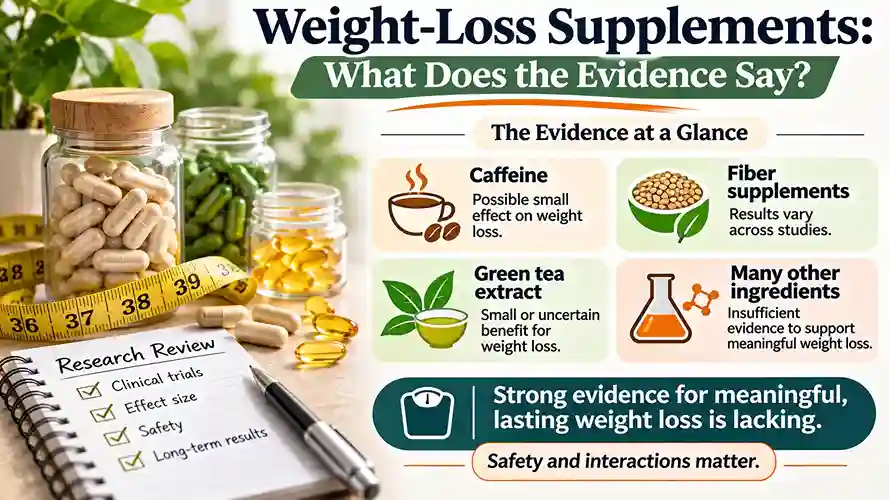
Do weight loss supplements work? Across every well-studied ingredient, the answer is the same: a little, briefly, and by less than most people expect. The NIH Office of Dietary Supplements puts it plainly — there is little scientific evidence that weight-loss supplements work. Here are the actual numbers from the trials, ingredient by ingredient.
What the trials measured
Americans spend roughly $2.1 billion a year on weight-loss supplements in pill form. Set against that figure, the measured effects are striking for how small they are. Each number below is the average extra weight lost compared with a placebo group:
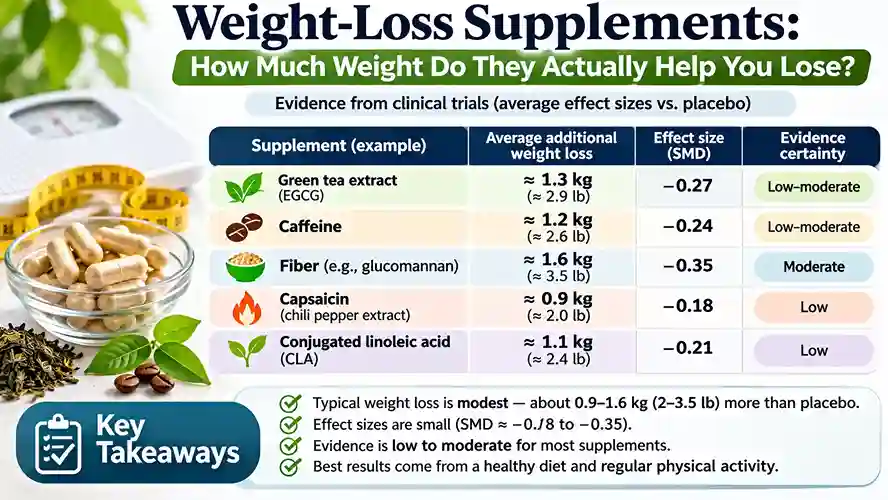
- Chitosan — 1.7 kg (Cochrane review, 13 trials, 4 weeks to 6 months). But the higher-quality trials showed minimal, probably clinically insignificant effects.
- Carnitine — 1.33 kg (2016 meta-analysis, 9 trials, 911 participants)
- Chromium picolinate — 1.1 kg (2013 Cochrane review, 9 trials, 622 participants). The authors called the clinical relevance “debatable” and rated the evidence low quality.
- Green tea extract — 0.95 kg (2012 Cochrane review, 14 trials, 1,562 participants). Outside Japan, the difference was not statistically significant.
- Garcinia cambogia — 0.88 kg short-term. When only the two rigorously designed trials were counted, the effect disappeared.
- Conjugated linoleic acid (CLA) — 0.7 kg body weight, 1.33 kg body fat. The authors described the effects as small, with uncertain clinical relevance.
- Glucomannan — no significant effect on body weight in a 2015 review of six trials
- Forskolin — no effect on body weight in 12-week trials
- Raspberry ketone — studied only alongside other ingredients. Evidence is insufficient to draw any conclusion.
Put the best result in everyday terms: 1.7 kg is under four pounds, achieved in trials running up to six months, by the ingredient whose better-designed studies then found almost nothing.
Why “statistically significant” is not the same as useful
Several of these ingredients do produce a measurable difference. That is a different claim from producing a difference worth having.
A trial with enough participants can detect a reliable 0.9 kg difference. Whether 0.9 kg over several months changes anyone’s health, clothing size or risk profile is a separate question — and it is the question the reviewers kept answering with words like “debatable” and “uncertain clinical relevance.”
Two other patterns recur. Effects shrink as study quality rises: both chitosan and garcinia looked better across all trials than they did in the well-designed subset. And results cluster by research group: the African mango trials were small, short, and run by the same authors, which is a reason for caution rather than confidence.
The ingredients with real safety signals
For most of this category the risk is wasted money. For three ingredients it is more than that.
Green tea extract is the one to take seriously. Concentrated extract is the leading cause of herbal and dietary supplement-induced liver injury in the United States, and the ODS flags liver damage as a concern, particularly with ethanolic extracts. This is specific to capsules and concentrated powders — drinking brewed green tea is not implicated.
Garcinia cambogia has been linked to 10 cases of liver toxicity, including one death and two liver transplants. Most of those products contained other ingredients too, so causation cannot be pinned on garcinia alone — but that caveat cuts both ways, since multi-ingredient “fat burner” blends are exactly how it is usually sold. Three cases of mania have also been reported.
Bitter orange (synephrine) carries the most serious reported harms: chest pain, elevated heart rate, anxiety, and in some cases heart attack, stroke and death. It is almost always combined with caffeine and other stimulants, which makes the individual contribution impossible to isolate and the combination harder to justify.
The problem that is not on the label
Beyond what the ingredients do, there is what is in the bottle that the label does not mention.
The FDA warns that contaminated products contain hidden ingredients which are often prescription drug ingredients, banned substances or harmful chemicals, posing a significant health risk that can lead to serious side effects and even hospitalisation. Weight-loss products are one of the largest categories in the agency’s tainted-products database.
The recurring adulterant is sibutramine, a controlled substance removed from the US market in October 2010 for safety reasons. It substantially raises blood pressure and pulse rate in some people and presents a significant risk for anyone with coronary artery disease, congestive heart failure, arrhythmias or a history of stroke. Someone taking an “all-natural” capsule has no way of knowing they are taking a withdrawn cardiovascular drug.
Phenolphthalein also turns up. The FDA reclassified it as not generally recognised as safe and effective in 1999, after studies indicated a potential cancer-causing risk.
Why this is legal
Dietary supplements are not regulated as drugs. They do not require premarket review or approval by the FDA. Manufacturers are responsible for ensuring their products are safe and their claims truthful, and the agency’s power is largely to act after a problem emerges.
So a product can reach shelves without a single trial behind it, and the testing that exposes a hidden drug typically happens after people are already taking it. Reading what a label does and does not commit to is the practical defence — see how to read a supplement label.
What actually moves the number
The ODS is direct on this point: lifestyle changes remain the basis of long-term weight loss. Diet, physical activity, sleep and, where appropriate, prescription medication supervised by a clinician have evidence behind them that no supplement ingredient in this category approaches.
If you want something from the shelf with a defensible rationale, caffeine has the clearest short-term effect on energy expenditure, and the FDA and EFSA consider up to 400 mg daily acceptable for healthy adults — about four cups of coffee. Tolerance appears to blunt the effect over time, and stacking it with other stimulants is where the harms concentrate.
Fibre supplements such as glucomannan did not shift body weight in the better review, but soluble fibre has independent benefits for cholesterol and blood sugar. Buying it for those reasons is reasonable; buying it to lose weight is not supported.
If you still want to try one
- Expect under 2 kg, if anything. Any product promising more than the trials found is telling you something about the seller.
- Avoid multi-ingredient “fat burners.” They are where the hidden drugs, the stimulant stacking and the liver cases concentrate.
- Check the FDA’s tainted-products database for the brand before buying.
- Stop immediately for yellowing skin or eyes, dark urine, persistent nausea, upper-right abdominal pain, chest pain or a racing heart — and see a doctor.
- Tell your doctor what you are taking, particularly if you are on blood pressure, heart, diabetes or thyroid medication.
The bottom line
Do weight loss supplements work? Measurably, in a few cases. Meaningfully, in none of them. The best-supported ingredients produce one to two kilograms over months, the better-designed trials consistently find less than the weaker ones, and three ingredients carry documented risks of liver injury or cardiovascular events.
Against that, the category sells $2.1 billion a year on the strength of claims no trial has ever supported. The most useful thing the evidence offers is permission to stop looking for the pill and spend the money elsewhere.
Sources
- NIH Office of Dietary Supplements — Dietary Supplements for Weight Loss (Health Professional Fact Sheet)
- FDA — Avoiding Products Contaminated with Hidden Ingredients
- LiverTox — Green Tea (NIH/NIDDK)
Frequently asked questions
Do weight loss supplements work?
Only marginally. The NIH Office of Dietary Supplements states there is little scientific evidence that they work, and the best-supported ingredients produced between 0.7 kg and 1.7 kg more weight loss than placebo in trials — effects reviewers described as of debatable or uncertain clinical relevance.
Which weight loss supplement has the most evidence?
Chitosan showed the largest average effect at 1.7 kg over placebo in a Cochrane review of 13 trials, but the higher-quality trials within that review found minimal, probably clinically insignificant effects. Carnitine (1.33 kg) and chromium picolinate (1.1 kg) follow.
Are weight loss supplements safe?
Several carry documented risks. Green tea extract is the leading cause of supplement-induced liver injury in the US, garcinia cambogia has been linked to 10 liver toxicity cases including one death and two transplants, and bitter orange has been associated with heart attack, stroke and death.
Can weight loss supplements contain hidden drugs?
Yes. Weight-loss products are one of the largest categories in the FDA’s tainted-products database. The most common adulterant is sibutramine, a drug withdrawn from the US market in 2010 that raises blood pressure and heart rate.
Does the FDA approve weight loss supplements?
No. Dietary supplements do not require premarket review or approval by the FDA. Manufacturers are responsible for safety and truthful labelling, and the agency generally acts only after a problem is identified.
Related articles

Hinuki Review: An Honest Look at All 22 Ingredients
Hinuki is a pomegranate jelly stick you squeeze into your mouth after meals, sold to curb appetite and make weight…
Slimzol Review: Scam or Legit? An Honest 21-Ingredient Look
Short answer: Slimzol is not a scam, but it is underdosed. This Slimzol review is built from the product’s printed…