Kerassentials Reviews: 1 Real Antifungal, Not for Nails

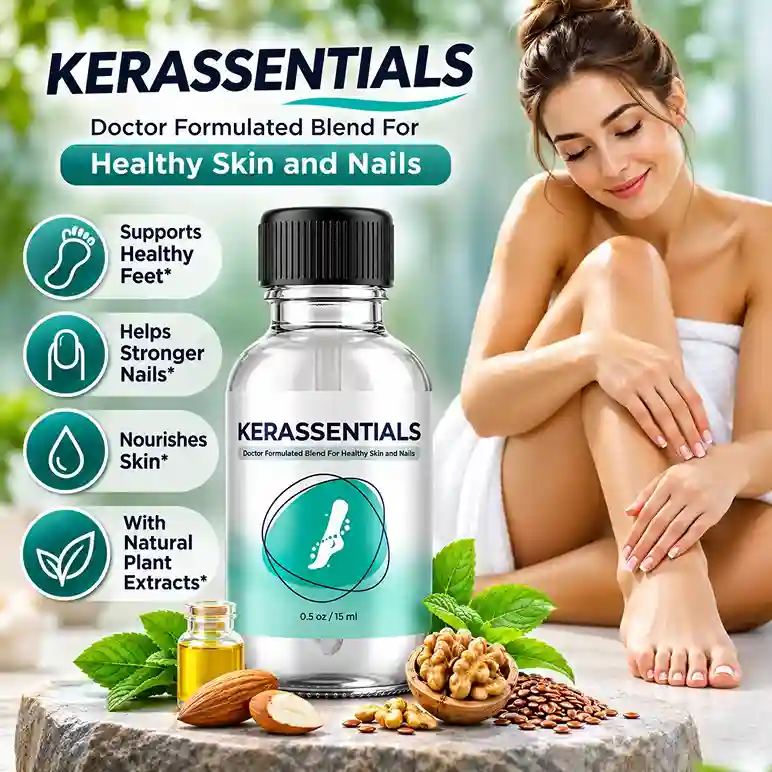
Kerassentials is an oil you brush on your nails for fungus. This Kerassentials review checks the eight ingredients against what nail fungus actually responds to.
One ingredient in here is a real antifungal drug that the FDA recognises. That sounds like good news until you read what its own labelling says about nails.
This article contains affiliate links. If you buy through one, we may earn a commission at no extra cost to you. How this works
What is Kerassentials?
Kerassentials is a topical oil you apply to the nail bed, once a day after showering. It’s sold for discoloured, thickened or crumbling nails.
Eight things are named on the label: lavender oil, organic flaxseed oil, almond oil, tea tree oil, lemongrass oil, aloe vera, vitamin E and undecylenic acid.
We built this Kerassentials review from the company’s own page and the published research on nail fungus treatment.
The page never states the bottle size. We searched it for millilitres and fluid ounces and found neither, so you’re buying by the bottle without knowing how much oil is in one.
No amounts or percentages are given for any ingredient either.
See the official page and current pricing
Why people try it
Nail fungus is stubborn, visible and embarrassing. It makes people hide their feet at the pool and keep their shoes on at other people’s houses.
It’s also genuinely common. One source puts it at one in two people over 70, and it accounts for about half of all nail disease.
Getting it treated properly means a doctor’s visit, a nail clipping sent for testing, and often months of treatment. An oil you can order privately skips all of that.
We understand the appeal completely. The problem is that nails are the hardest place on the body for anything topical to reach.
How to use Kerassentials
The instruction is once a day, after your shower, applied to the nail bed.
Hold onto that detail. It becomes important when we get to the research, because the trial behind the main ingredient used a very different routine.
The page says improvements show “within the first weeks” and that six bottles will cover a full course of treatment.
Six months is a realistic timeline for any nail treatment, because you cannot heal a damaged nail — you can only grow a new one. A toenail takes 12 to 18 months to replace itself completely.
What’s in Kerassentials

Two of these are worth real attention. The rest are carrier oils and moisturisers.
Undecylenic acid — the one that’s actually a drug
This is the most interesting ingredient we’ve come across in this whole series, and it’s why this review exists.
Undecylenic acid isn’t a herbal extract. It’s a recognised over-the-counter antifungal drug, on the FDA’s approved list for topical antifungals at 10% to 25% strength.
So Kerassentials contains a genuine antifungal medicine. Here’s the part the sales page leaves out.
Every FDA-registered undecylenic acid product carries the same required sentence on its label: “This product is not effective on the scalp or nails.”
That isn’t our interpretation. It’s the mandated wording, and it appears on product after product. The monograph covers athlete’s foot, jock itch and ringworm — skin conditions. Not nails.
There’s even an over-the-counter product sold as a “Nail Fungus Treatment Pen” built on undecylenic acid. Its own FDA label carries that same sentence saying it isn’t effective on nails.
The Kerassentials page describes this ingredient only as a “beneficial fatty acid” that “helps prevent fungus.” It never mentions that it’s a regulated antifungal drug — or what that drug’s labelling says about nails.
Tea tree oil — the best-evidenced thing in the bottle
Tea tree oil has something almost no home remedy has: actual randomised trial evidence for nail fungus. Apple cider vinegar and hydrogen peroxide can’t clear that bar.
In a double-blind trial of 177 people with toenail fungus, tea tree oil performed about as well as clotrimazole, a standard antifungal drug.
That’s a real result. But look closely at how it was done, because all three details differ from Kerassentials:
- The trial used 100% tea tree oil. Kerassentials is a blend of eight things, so tea tree is a fraction of the bottle — and the fraction isn’t disclosed.
- It was applied twice daily. Kerassentials says once.
- Every participant had serial debridement — the nail physically filed and ground down at intervals by a clinician. Kerassentials mentions nothing of the kind.
That last one may be the most important. Debridement removes the barrier, and nothing you brush on gets through a thick nail without it.
There’s a second trial worth knowing about. It reported an 80% cure rate using 5% tea tree oil — combined with butenafine, a pharmaceutical antifungal.
Tea tree oil alone did substantially worse. The impressive number came from the drug being in the mix.
The other six
Lavender, flaxseed, almond, lemongrass, aloe vera and vitamin E. These moisturise and carry the active ingredients, and some have mild antifungal activity in a laboratory dish.
None has trial evidence for nail fungus. The page calls aloe vera a “strong antifungal,” which overstates it considerably.
Worth noting too: the page displays a “No Chemicals” badge while listing undecylenic acid and tocopheryl acetate — both chemicals, one of them a regulated drug substance.
Check the full ingredient list on the official page
Does Kerassentials work?

To answer that fairly you need to know how badly everything works on nails. These are the numbers for prescription treatments.
“Complete cure” means a clear nail and no fungus detectable. It’s the honest measure, and it’s brutal:
- Ciclopirox 8% lacquer — 5.5% to 8.5% complete cure
- Amorolfine 5% lacquer — around 15% to 18%
- Efinaconazole 10% lacquer — around 15% to 26%
- Oral terbinafine tablets — 35% to 78%
Those lacquer figures are after daily application for 48 weeks. Ciclopirox fails for more than 60% of the people who use it properly for a year.
And these are prescription products engineered specifically to penetrate the nail plate. That penetration chemistry is the whole reason they exist.
So the realistic ceiling for Kerassentials isn’t zero. Tea tree oil has evidence, and undecylenic acid is a real antifungal.
But this is an undisclosed blend, applied half as often as the trial used, with no filing down of the nail — against a condition where purpose-built prescription lacquers manage 15%.
The one clear conclusion from the research: tablets beat anything you paint on. Oral terbinafine is more effective than every topical treatment, and it’s often cheaper than them too.
That’s the hard finding behind this Kerassentials review, and it applies to every nail oil on the market, not just this one.
Compare the company’s claims against these numbers
Please read this part before you self-treat
This is the most important section of this Kerassentials review, and it has nothing to do with the product.
Roughly half of abnormal-looking nails aren’t fungal. Nail fungus accounts for about 50% of nail disease, which means the other half is something else — psoriasis, old trauma, lichen planus, bacterial infection.
And one of the conditions that mimics nail fungus is melanoma under the nail.
It is frequently mistaken for a fungal infection or a bruise. Reports describe around 85% of cases being misdiagnosed initially, and an average diagnostic delay of about two years — which is why survival figures for it are poor.
In one published case a man spent a year having his thumbnail treated at a nail salon for what everyone assumed was fungus. It was melanoma.
In another, nail clippings confirmed genuine fungus — and a melanoma was found underneath anyway. Having fungus doesn’t rule anything else out.
So before you treat a nail for six months, get it diagnosed. A doctor takes a clipping and has it tested. It’s quick, and it’s the one step that matters more than which product you choose.
See a doctor rather than self-treating if you have diabetes, poor circulation or a weakened immune system, if the nail is painful, or if there’s a dark streak or patch in it.
What works better
In rough order of how well the evidence supports it:
- See a doctor about oral terbinafine. It’s the most effective treatment by a wide margin and usually costs less than the topicals. It needs a prescription and a liver-function check, which is exactly why a proper diagnosis comes first.
- A prescription lacquer if tablets aren’t suitable for you. Still modest odds, but built to penetrate the nail.
- Debridement. Having the nail thinned by a podiatrist, or filing it down yourself, improves what any topical can do. The tea tree trial included it for a reason.
- Plain 100% tea tree oil, twice a day, if you want to try the evidence-backed version of what Kerassentials is selling. It’s sold in any health shop for a few pounds and costs a fraction of $49 a bottle.
That last point is the practical one. The ingredient with the best evidence in this bottle is cheap, sold everywhere, and was studied at a strength and frequency this product doesn’t use.
Also worth doing regardless: treat your shoes, keep feet dry, and don’t share nail clippers. Reinfection is common.
Kerassentials reviews and complaints
Searching for a Kerassentials review turns up mostly affiliate pages. The company’s own site claims a rating “based on 14,576 reviews” — we found no source for that figure and no way to read any of them.
There’s no Amazon listing and no retail presence, so there’s no independent verified-buyer record to check it against.
Three testimonials appear, each marked “Verified Purchase,” with first and last names and US cities. No doctor is named anywhere, though a photo of one appears on the page.
The reference list
Credit where it’s due: Kerassentials does carry a reference list, and 29 entries is more than most products in this category bother with.
The trouble is what’s in it. Many entries cover subjects with no bearing on the product — chia seed oil, walnut oil, camphor used against plant diseases, diabetic foot infections. One entry is incomplete.
Others are general antifungal or nail-fungus papers, which is fair enough. But none tests Kerassentials itself, and nothing in the list addresses the central problem of whether this blend penetrates a nail.
The page also cites the US CDC for the claim that most people stop antifungal treatment too early. That’s a reasonable point, and it’s true — but it’s an argument for finishing a real treatment, not for starting this one.
Read the company’s own claims and references
Is Kerassentials safe?
Nothing in this Kerassentials review points to a safety problem. Applied to a toenail, these are common cosmetic oils plus a long-established topical antifungal.
The realistic concerns are irritation and delay, not toxicity:
- Tea tree and lemongrass oils can irritate skin, especially undiluted or on broken skin around the nail. Stop if the area becomes red or sore.
- Allergic reactions to tea tree oil are well documented. Try a small patch first.
- Almond oil matters if you have a nut allergy.
- Check with a doctor first if you’re pregnant or breastfeeding, as the page itself advises.
- Never use this instead of care for a diabetic foot problem. Foot infections in diabetes can escalate quickly and need medical attention.
The real risk is the months spent brushing on oil while an undiagnosed nail problem continues.
Kerassentials price
Three options, sold through ClickBank:
| Package | Per bottle | Total | Page’s “regular” price | Shipping |
|---|---|---|---|---|
| 2 bottles | $79 | $158 | $358 | +$9.99 |
| 3 bottles | $69 | $207 | $537 | Free US |
| 6 bottles | $49 | $294 | $1,074 | Free US |
The arithmetic is internally consistent, which is more than we can say for several products we’ve reviewed. Every total multiplies correctly, and the savings badges add up against a stated regular price of $179 a bottle.
That said, $179 a bottle is a figure nothing appears to sell at, so the “savings” are measured against a reference price rather than a real one.
The 6-bottle option adds three ebooks with listed values of $55, $54 and $54. Digital guides cost nothing to deliver, so treat those numbers as presentation rather than value.
Since no bottle size is published, there’s no way to work out what you’re paying per millilitre — unusual for a topical product.
The guarantee
A 60-day money-back guarantee, described as no questions asked, covering any reason for changing your mind.
Here’s why that’s actually solid: ClickBank is the retailer, and 60 days is ClickBank’s own default refund window. The promise matches the platform’s standard policy rather than exceeding it.
That means if the seller goes quiet, you can contact ClickBank directly with your order number and they will process the refund themselves. You’re not relying on the vendor’s goodwill.
One timing problem to plan around. The page itself says six bottles cover a full course, and any nail treatment needs months to show anything. Your 60 days will expire long before you can judge the result.
So decide by day 50 whether you’re seeing new clear nail growing from the base, and claim the refund if you aren’t.
See the official refund policy
Check the current guarantee terms
Our verdict
This is the closest thing to a reasonable product we’ve looked at in this series, and it still doesn’t work out.
It contains two ingredients with genuine antifungal credentials. Tea tree oil has real randomised trials. Undecylenic acid is a recognised over-the-counter antifungal drug. The pricing arithmetic is honest, the guarantee matches ClickBank’s standard, and there’s a reference list.
But both credentials point away from the product. Undecylenic acid’s own labelling states it isn’t effective on nails, on every registered product containing it.
And tea tree oil’s evidence comes from pure oil, twice daily, with the nail physically ground down — three things this product doesn’t do.
Meanwhile prescription lacquers designed to penetrate nail manage a complete cure around 15% of the time, and tablets that work far better often cost less.
If you want what’s good in this bottle, buy tea tree oil and a nail file. Then go and get the nail looked at.
What to do next
- Get the nail diagnosed first. Half of bad-looking nails aren’t fungal, and one of the mimics is serious. A clipping test settles it.
- Ask about oral terbinafine. It’s the most effective option by a wide margin and often the cheapest.
- If you want a topical, ask about a prescription lacquer and have the nail debrided alongside it.
- If you’d rather try the natural route, buy 100% tea tree oil and apply it twice daily, filing the nail down as you go. That’s the version that was actually tested.
- If you still buy Kerassentials, mark day 50 on your calendar and claim the refund then if nothing new is growing in.
Does Kerassentials really work?
Unlikely as directed. Its antifungal drug ingredient, undecylenic acid, carries a required label statement on every registered product saying it isn’t effective on nails. Even prescription nail lacquers built to penetrate the nail only fully cure around 15% of cases.
What are the Kerassentials ingredients?
Lavender oil, organic flaxseed oil, almond oil, tea tree oil, lemongrass oil, aloe vera, vitamin E and undecylenic acid. No amounts or percentages are published, and the bottle size isn’t stated anywhere.
Does tea tree oil work on toenail fungus?
It has genuine randomised trial evidence, which most home remedies don’t. But the trial used 100% tea tree oil twice daily for six months, with the nail physically filed down at intervals. Kerassentials is a blend applied once a day.
What actually works best for nail fungus?
Oral terbinafine tablets, with complete cure rates of roughly 35% to 78% versus about 15% for prescription topical lacquers. It’s often cheaper than the topicals too, but needs a prescription and a liver check.
Is Kerassentials legit?
It’s a real product sold through ClickBank with a 60-day guarantee that matches ClickBank’s own default, and its pricing arithmetic is consistent. But the 14,576 reviews it cites have no visible source, and its 29 references include papers on chia seed oil and plant diseases.
Should I see a doctor about my nail?
Yes, before treating it for months. Only about half of abnormal-looking nails are fungal, and melanoma under the nail is regularly mistaken for fungus — reports describe roughly 85% of those cases being misdiagnosed at first. A clipping test settles it quickly.
Is Kerassentials safe?
Low risk applied to a toenail, though tea tree and lemongrass oils can irritate skin and tea tree allergy is well documented. It contains almond oil, so avoid it with a nut allergy, and never use it in place of medical care for a diabetic foot problem.
Where this came from
Product details, pricing and claims come from the company’s own page, checked on 22 November 2026. Here’s the research behind this Kerassentials review.
- DailyMed — Undecylenic acid 25% antifungal label — the required “not effective on the scalp or nails” statement
- Onychomycosis: Old and New — complete cure rates for ciclopirox, amorolfine, efinaconazole and terbinafine
- AAFP — Onychomycosis: Rapid Evidence Review — terbinafine as first-line, and cheaper than topicals
- Natural Treatment Options for Nail Disorders — the 177-person tea tree oil trial with serial debridement
- Subungual Amelanotic Melanoma Masquerading as Onychomycosis
- A Misdiagnosed Case of Malignant Melanoma in an Infected Nail — the misdiagnosis rate and delay
- ClickBank — Flexible refunds — the 60-day default window