Kinzeno Review: 4 Things to Know Before You Subscribe

Sore knee, stiff back, aching shoulder — and someone’s advertising a gel that promises to sort it out. This Kinzeno review tells you what the gel is, what’s in it, whether any of it stands up, and what works better for less. One thing up front if you’re in a hurry: the order page ticks a monthly subscription for you unless you change it.
This article contains affiliate links. If you buy through one, we may earn a commission at no extra cost to you. How this works
What is Kinzeno?
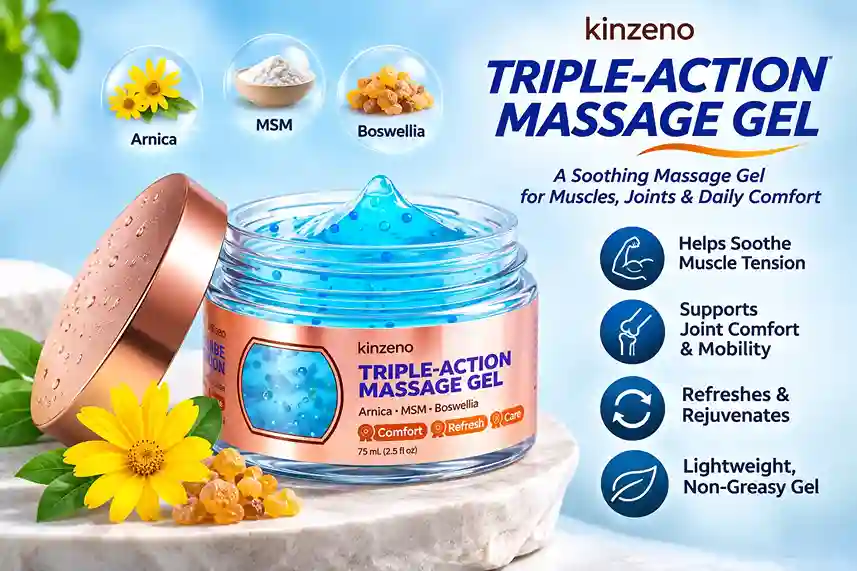
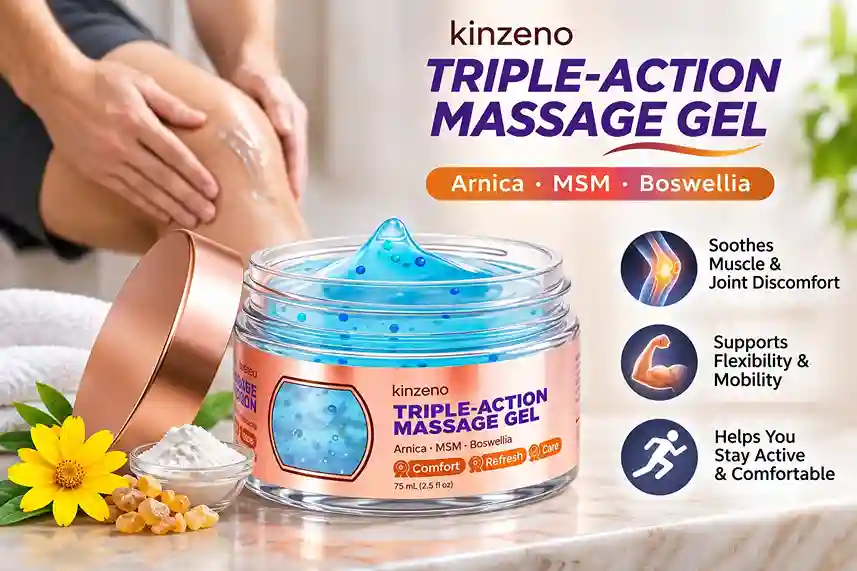
Kinzeno is a gel you rub into sore muscles and joints. You don’t swallow it — it goes on your skin, like a sports rub or a muscle cream from the chemist.
The brand calls it a “triple-action massage gel.” That’s their own description, not an independent finding, so take it as marketing language rather than a tested claim.
What you get
It comes in small jars of 75 ml (2.5 fl oz). The main ingredients listed are magnesium, MSM, arnica, frankincense, B vitamins and horse chestnut — plus ten more the company doesn’t name.
You can only buy it from their own website. It isn’t in shops.
See the official page and current pricing
Why people try it
If you’ve got an achy joint or a muscle that won’t settle, you’ve probably already tried the obvious things. Painkillers upset some people’s stomachs. Nobody wants to be taking tablets every day for a sore knee. So a gel you rub on sounds ideal — you put it where it hurts, nothing goes through your system, and it feels like you’re doing something.
That instinct is sound. Rub-on treatments genuinely are a good idea for localised aches, and some of them work very well. We’ll come back to that.
The idea behind Kinzeno
The thinking goes like this. Magnesium helps muscles relax. Arnica has been used on bruises and sprains for centuries. Frankincense and MSM are associated with easing inflammation. Put them all in a gel, rub it in, and those effects happen where you need them.
It’s a reasonable-sounding story, and it’s why these gels sell. Whether the ingredients actually behave that way when you rub them on skin is a separate question, and that’s the part this review digs into.
How to use Kinzeno
Straightforward enough. Take a coin-sized amount and massage it into the sore area in a circular motion until it’s absorbed.
The company says you can repeat it two to four times a day.
A few practical things
- Wash your hands afterwards, and keep it well away from your eyes.
- Don’t put it on broken skin, cuts, or a rash.
- Give it a fortnight before deciding. Anything that genuinely helps a long-standing ache takes more than a day or two.
- Keep a note of how your joint feels each day. Without it you’ll have no idea afterwards whether it made a difference.
At two to four times a day, a 75 ml jar won’t last long. Worth bearing in mind when you look at the prices further down.
Check the current price on the official page
Kinzeno ingredients: what’s actually in it
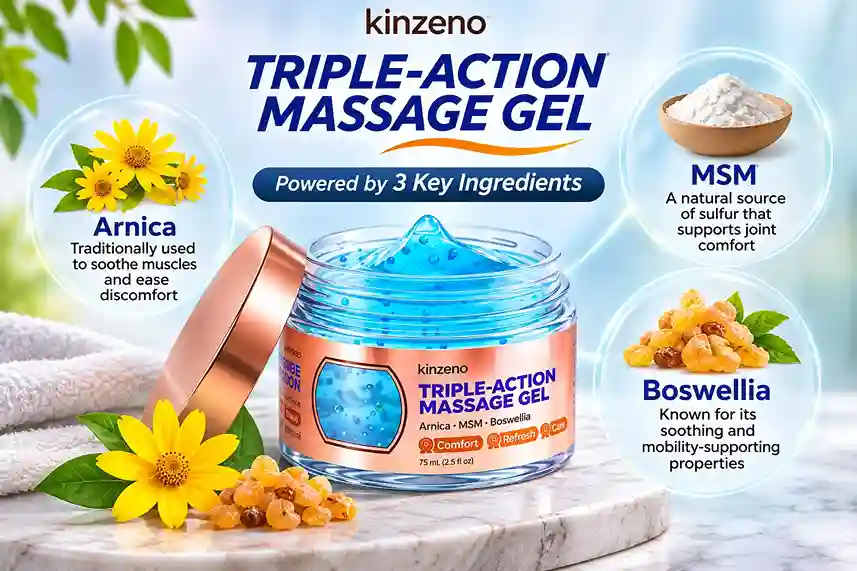
Before we go through them, one thing matters more than any individual ingredient: the company doesn’t say how much of anything is in the jar. No amounts, anywhere. And ten of the ingredients aren’t even named.
That’s a real problem. With any gel, the amount is what decides whether it does anything. Here’s what the research says about the ones we do know about.
Magnesium — the headline, and the weak link
Magnesium is listed first and it’s the selling point of most gels like this. The trouble is getting it through your skin.
Magnesium particles carry a double electrical charge, which makes it physically hard for them to cross intact skin. That’s chemistry, not opinion. And when researchers have looked, the evidence that meaningful amounts get through, or that it changes anything in your body, is very limited.
Put plainly: no study has shown a health benefit from putting magnesium on your skin. A 2025 trial of a shop-bought magnesium gel found it didn’t help muscle recovery — the main reason people buy it. UK health guidance doesn’t list it among recommended treatments for ordinary aches and pains.
Magnesium swallowed as a tablet is a different matter and genuinely helps people who are short of it. Rubbed on, the case hasn’t been made.
Arnica — traditional, thin evidence
Arnica has been rubbed on bruises and sprains for generations and turns up in most of these products. The research behind it is thin — reviewers describe the evidence as weak.
It’s unlikely to do you any harm on unbroken skin. It’s just not the reason a gel works.
MSM, frankincense, horse chestnut and B vitamins
MSM has reasonable evidence for joint pain when you swallow it. Rubbed on, there’s very little to go on.
Frankincense is the same story — decent research as a capsule, far less as a cream.
Horse chestnut is the most promising of the group. Its active compound has genuine research behind it for swelling and poor circulation in the legs. Whether a small amount in a general-purpose gel does anything is another matter, and again, no amount is given.
B vitamins through the skin are unlikely to do much.
Does Kinzeno work?
Honestly? Nobody can tell you — including the company, because they haven’t published the amounts.
What we can say is this. Most rub-on gels produce a real, immediate feeling of relief, and a good part of that is the massage itself. Rubbing a sore spot increases blood flow and genuinely feels better. That effect is real. It just isn’t the ingredients doing it, and you’d get it from any cream.
Beyond that: the headline ingredient has little evidence of even reaching your muscle, the second one has weak evidence, and the rest are in unknown quantities.
So — a gel that’s pleasant to use, very unlikely to hurt you, might take the edge off, backed by a 60-day guarantee. That’s a fair description. It isn’t a strong one, and it’s an expensive way to get a massage.
Check the official page for current details
The gel that does work, and costs far less
This is the part worth keeping whatever you decide.
If you want a rub-on treatment that’s been properly tested, anti-inflammatory gels — diclofenac, ibuprofen or ketoprofen — have some of the best evidence of any pain treatment going. In the US you can buy diclofenac gel over the counter, no prescription needed.
Researchers pooled 61 studies covering 8,386 people. For strains, sprains and pulled muscles:
- 7 or 8 people in 10 using diclofenac or ketoprofen gel had much less pain after a week
- Against 2 or 3 in 10 using a dummy gel
- Side effects were minimal
That’s rated high quality evidence, and it’s about as clear a result as you’ll find anywhere in pain treatment.
For long-term joint problems like knee arthritis the benefit is smaller — roughly 10% more people get good relief than with a dummy gel — but it’s measured, real, and more than anything Kinzeno can show.
A tube costs a few pounds or dollars at any pharmacy. One purchase, no subscription.
What else helps a sore joint or muscle
- Keep it moving. Resting a sore joint completely usually makes it stiffer. Gentle movement beats none.
- Heat for stiffness, cold for a fresh injury. A hot water bottle or a bag of frozen peas costs nothing.
- Strengthen the muscles around it. For knees especially, stronger thighs reduce pain more reliably than anything you rub on.
- Lose a bit of weight if you can. Every pound off takes several pounds of load off your knees with each step.
- See a physiotherapist if it’s dragged on for weeks. A few sessions of the right exercises beats years of gel.
See a doctor if the joint is hot or swollen, if it locks or gives way, or if the pain wakes you at night. Those aren’t things to treat with a cream.
Kinzeno reviews and complaints
There’s no trustworthy pool of customer reviews. It’s sold only from the company’s own website, so there’s no shop listing where real buyers leave feedback anyone can check.
The site mentions joining “30,000+” people. There’s no way to verify that number and no independent source for it.
Is Kinzeno safe?
For a gel on unbroken skin, the risk is low. The usual problem with anything topical is skin irritation — redness, itching, or a rash where you’ve put it.
The company’s own warnings are sensible: external use only, keep it away from your eyes, nose and mouth, and stop if your skin reacts. It also says to check with a healthcare professional first if you have a medical condition.
Two we’d add. Don’t use it on cuts, broken skin or a rash. And if you’re pregnant, arnica is usually avoided — ask your midwife or doctor first.
Kinzeno price and where to buy
The subscription box is already ticked
This is the thing to watch, and it’s easy to miss.
When you reach the order page, “Subscribe & Save” is already selected. Every big discount you can see — the 70% off, the $17.99 a jar — is a subscription price. Underneath the packages, in small grey text, it says “Billed every month.”
There is a “One-Time Purchase” option. It’s the second button and you have to click it yourself. If you don’t, you’ve agreed to a recurring monthly charge rather than a single order.
In fairness, the page does say “cancel anytime” and “no hidden fees,” and plenty of honest companies sell this way. But an unnoticed subscription is the most common complaint about products sold like this. If you want one order, click “One-Time Purchase” before you pay.
What it costs
| Package | Size | Per jar | Total | Per ml |
|---|---|---|---|---|
| 1 jar | 75 ml | $44.99 | $44.99 | $0.60 |
| 2 jars | 150 ml | $29.99 | $59.98 | $0.40 |
| 3 jars | 225 ml | $21.99 | $65.97 | $0.29 |
| 4 jars | 300 ml | $17.99 | $71.96 | $0.24 |
Those are the subscription prices, billed monthly. The one-time price will be different.
About the “70% off”
Every discount is worked out against $59.99 for one 75 ml jar. That’s where “$239.96” for four jars comes from.
Judge it on what actually leaves your account. At best that’s $71.96 for 300 ml — roughly 24 cents a millilitre, and only if you remember the subscription renews. Set against a pharmacy gel with real evidence behind it, bought once, the gap is large.
View current packages and pricing
The 60-day guarantee
There’s a condition worth noticing. It covers unused product returned within 60 days, and you pay the return postage.
That’s narrower than it sounds. Buy four jars, open one to see if it helps, and you can only send back the three you haven’t touched.
So if you’re going to try it:
- Buy one jar first, not four.
- Click “One-Time Purchase” unless you genuinely want it every month.
- Leave the spare jars sealed until you’ve decided.
- Put the 60-day deadline in your phone the day it arrives.
- Check your bank statement next month to make sure you weren’t charged again.
Our Kinzeno review verdict
Kinzeno Massage Gel
Kinzeno is a low-risk gel that will feel pleasant and may take the edge off an ache — though much of that is the massage, not the ingredients. What it isn’t is good value. The main ingredient struggles to get through skin, no amounts are published, and an anti-inflammatory gel from any pharmacy has far better evidence at a fraction of the price. If you do order, click “One-Time Purchase” and start with one jar.
Strengths
- Low risk on unbroken skin
- Clear, sensible safety warnings
- Massaging a sore area genuinely does feel better
- Horse chestnut has real research behind it for swelling
- 60-day guarantee on unused jars
- Customer service numbers for three countries
Limitations
- The order page ticks a monthly subscription by default
- No amounts given for any ingredient
- Magnesium, the main ingredient, barely absorbs through skin
- Arnica evidence is weak
- Ten ingredients are not even named
- No company name or address on the site
- Costs far more than a pharmacy gel with much better evidence
- Guarantee covers unopened jars only, and you pay the postage
Check availability and guarantee terms
What to do next
- Try a pharmacy anti-inflammatory gel first. Cheap, one purchase, best evidence of anything you can rub on.
- Add the free things: keep the joint moving, heat for stiffness, cold for a fresh injury.
- Strengthen the muscles around the painful joint. This is what changes things over months rather than minutes.
- Get it looked at if it’s lasted weeks, or the joint is hot, swollen, or waking you at night.
- Then try Kinzeno if you still fancy it — one jar, one-time purchase, deadline in your calendar.
Go to the official Kinzeno page
Common questions
Is Kinzeno a subscription?
By default, yes. “Subscribe & Save” is pre-selected on the order page and the small print says “billed every month.” There’s a one-time purchase option, but you have to click it yourself before paying.
Is Kinzeno legit, or is it a scam?
It’s a real product with a working order process, customer service numbers and a 60-day guarantee. But no company name or address appears anywhere on the site, and no amounts are given for any ingredient.
Does Kinzeno work for joint pain?
There’s no way to tell, because the amounts aren’t published. Magnesium, the lead ingredient, has very little evidence of absorbing through skin at all, and arnica evidence is weak. Much of what people feel from any massage gel comes from the massage itself.
What are the Kinzeno ingredients?
The site names magnesium sulfate and chloride, MSM, arnica montana, frankincense, a B-vitamin complex and horse chestnut — then says there are “10 more” without listing them. No amounts are given for any.
What's a cheaper alternative to Kinzeno?
An over-the-counter anti-inflammatory gel from any pharmacy. Across 61 studies covering 8,386 people, 7 or 8 in 10 using diclofenac or ketoprofen gel had much less pain from a strain or sprain after a week, against 2 or 3 in 10 using a dummy gel.
How does the Kinzeno guarantee work?
You have 60 days, it covers unused product only, and you pay the return postage. Opened jars can’t be returned — so buy one jar first rather than four.
Where this came from
Here’s the research behind this Kinzeno review, so you can check it yourself.
- Anti-inflammatory gels for sudden muscle and joint pain — 61 studies, 8,386 people
- Anti-inflammatory gels for long-term joint pain
- A review of diclofenac gels, solutions and patches for knee arthritis
- An overview of all the research on rub-on painkillers