SodaMelt Reviews: 4 Laxative Herbs in One Capsule

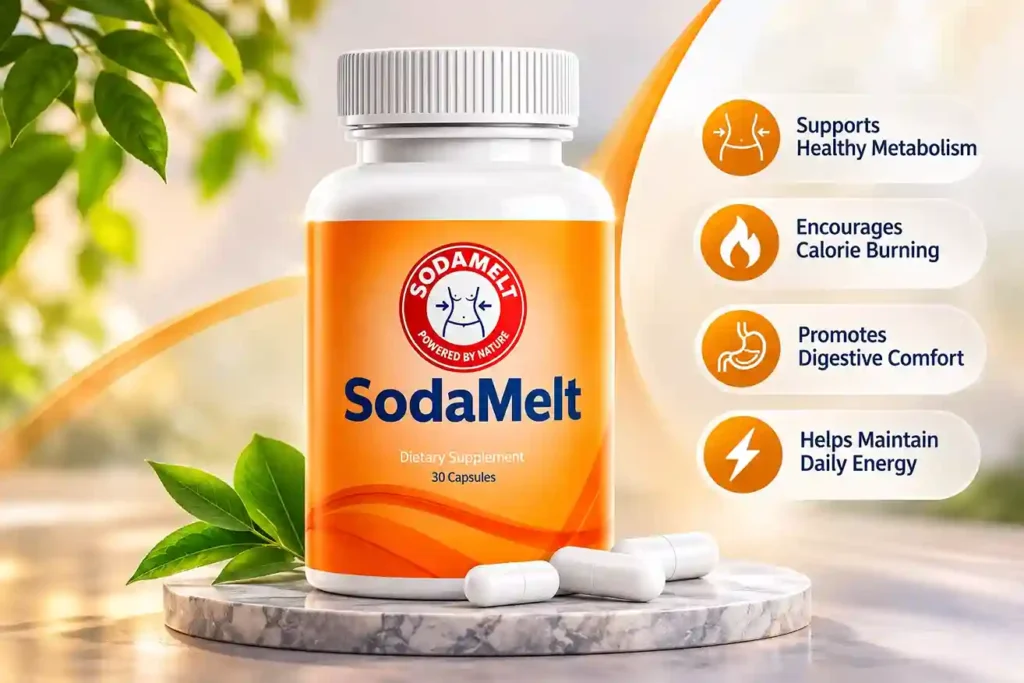
SodaMelt is a once-a-day capsule sold for digestion, bloating and “a lighter feeling.” This SodaMelt review is built from the actual Supplement Facts label.
The page promises no harsh laxatives. The label lists four herbs that are traditional stimulant laxatives — and they’re the only ingredients present in amounts likely to do anything.
This article contains affiliate links. If you buy through one, we may earn a commission at no extra cost to you. How this works
What is SodaMelt?
SodaMelt is one capsule a day, taken with a large glass of water 20 to 30 minutes before a meal. A bottle holds 30 capsules.
It’s marketed as a “natural metabolic wellness formula” for bloating, heaviness after meals, sluggish digestion and feeling lighter.
The label lists 12 ingredients. Eleven of them sit inside a single proprietary blend, so you can’t see how much of each you’re getting.
We read the amounts off the product label for this SodaMelt review, because the sales page doesn’t publish a single number.
See the official page and current pricing
Why people try it
Bloating and that heavy, sluggish feeling after eating are genuinely miserable, and genuinely common. The page describes them well.
It also leans on the word “lighter” throughout, and on a product name built around melting. The implication is weight, even though the page never quite promises it.
That gap between what’s implied and what’s claimed is the thing to watch here, and it’s why the ingredient list matters so much.
How to take SodaMelt
One capsule daily with 8 oz of water, before a meal.
The water instruction isn’t incidental. Fibre supplements need plenty of fluid, and so do the other ingredients in here, for reasons we’ll come to.
The label’s own caution says not to exceed the recommended dose, and that pregnant or nursing women, under-18s and anyone with a medical condition should speak to a doctor first.
What’s actually in SodaMelt

Here’s the entire Supplement Facts panel, per capsule:
| Ingredient | Amount |
|---|---|
| Calcium (as calcium carbonate) | 100 mg |
| Proprietary blend of 11 ingredients | 250 mg total |
That’s it. 350 mg in total, and 100 mg of that is chalk.
The eleven in the blend: oat straw, alfalfa, psyllium husk, Chinese rhubarb root, scabrous gentian root, aloe vera leaf, cascara sagrada bark, goldenseal root, buckthorn, bentonite clay and Lactobacillus acidophilus.
Split evenly, that’s about 23 mg each. They won’t be split evenly, but no amount is disclosed for any of them.
Check the label on the official page
The four laxative herbs
This is the part that matters most, so we’ll be precise about it.
Four ingredients in that blend are traditional stimulant laxatives — herbs containing compounds called anthraquinones, which work by prompting the bowel to contract. This is the central finding of our SodaMelt review:
- Cascara sagrada bark
- Chinese rhubarb root
- Buckthorn bark
- Aloe vera leaf — the leaf, which contains the laxative compound, as distinct from the inner gel
Meanwhile the sales page states the product is designed for a daily ritual “without harsh laxatives,” and describes every ingredient as “non-habit-forming.”
Stimulant laxatives are the one laxative class most associated with the bowel becoming reliant on them over time. That’s the opposite of non-habit-forming.
What the FDA said about two of them
In 2002 the FDA issued a final rule removing aloe and cascara sagrada from the approved list of over-the-counter laxative ingredients.
The agency’s reasoning was that it had asked manufacturers for safety data — on cancer risk and genetic damage — and hadn’t received it. It did not find proven harm in people.
Two things follow from that, and both matter:
First, this applies to products sold as medicines, with a Drug Facts panel. A dietary supplement sits outside that rule, which is how these ingredients are still legally sold.
Second, the European regulator limits cascara use to about a week, and noted there are no controlled trials of cascara on its own. This is not an ingredient designed for daily use over six months.
SodaMelt is sold in 90-day and 180-day packs.
Does SodaMelt work?

Here’s the honest answer: something will probably happen, but not for the reason the page gives.
The fibre can’t be doing it
The page’s strongest evidence is psyllium. It correctly notes that psyllium is the fibre the American College of Gastroenterology recommends for IBS, and cites a 2009 BMJ trial of 275 patients.
That trial is real and it’s good. It used 10 grams of psyllium a day for 12 weeks.
Ten grams is 10,000 mg. SodaMelt’s entire blend — all eleven ingredients together — is 250 mg.
So even if the capsule were nothing but psyllium, it would hold 2.5% of the studied dose. Shared eleven ways, it’s likely closer to a four-hundredth of it.
There’s an awkward detail in that citation too. The placebo arm of the trial the page relies on was 10 g of rice flour — and rice flour is the first filler listed on SodaMelt’s own label.
The probiotic can’t be doing it either
Probiotics are measured in billions of live organisms. The label gives no count for the Lactobacillus acidophilus, and it’s listed last in a 250 mg blend, which by convention means the smallest amount.
Which leaves the laxatives
Anthraquinone laxatives are different. They are pharmacologically active at a few tens of milligrams — amounts that genuinely can fit in a 250 mg blend.
So of the twelve ingredients, the ones plausibly present at a working dose are the four the page says aren’t there.
If you take this and feel lighter, that’s the most likely explanation. Not metabolism.
That single finding is what this SodaMelt review comes down to, and it’s why the next section matters more than the price.
Compare this against the company’s own page
Please read this before you buy
This is the most important section here, and it’s the reason we’ve been so specific about the ingredients.
Laxatives do not cause fat loss. This is settled, and it’s worth understanding why.
Food is digested and absorbed in the small intestine. By the time anything reaches the large intestine, where laxatives act, roughly 90 to 95% of the calories are already in your bloodstream.
What comes out after a laxative contains very little food, fat or calories. Any drop on the scale is water, and it returns as soon as you rehydrate.
Regular use carries real risks: dehydration, electrolyte imbalance, and with prolonged misuse, a bowel that struggles to work without help.
A product named for melting, sold on the promise of feeling lighter, built on laxative herbs, is a combination worth naming plainly. If the number on the scale is what you’re after, this cannot deliver it.
If you find yourself using laxatives to control your weight, that’s worth talking to someone about — your doctor, or the National Alliance for Eating Disorders helpline, which offers free support from licensed clinicians.
What works better
For bloating and sluggish digestion, the good news is that the one well-evidenced ingredient here is cheap and sold everywhere:
- Psyllium husk at a real dose. Plain psyllium powder costs a few pounds for a month and lets you reach the 10 grams the research used. Start at a teaspoon with plenty of water and build up over two weeks, or you’ll feel worse before better.
- A proper probiotic with the strain and the CFU count printed on the tub, rather than an unnamed amount inside a blend.
- Water and movement. Dull, but both do more for sluggish digestion than 23 mg of anything.
- For occasional constipation, a pharmacist can point you to an osmotic laxative, which is the class generally preferred for anything beyond short-term use.
And if bloating is persistent, severe, or comes with weight change, pain or bleeding, that’s a doctor’s appointment rather than a supplement.
See the official page for yourself
SodaMelt reviews and complaints
Searching for a SodaMelt review turns up mostly affiliate pages. There’s no Amazon listing, no retail shelf and no independent verified-buyer record we could find.
The page carries no testimonials at all and names no doctors. We’d rather see none than fabricated ones, and that’s worth saying.
Its one customer statistic is “94% of customers choose the 6-bottle pack.” No source, and it isn’t a claim about whether the product works — it’s a nudge toward the largest order.
The reference list
SodaMelt lists 10 references, most with PubMed IDs, and names real studies and authors. That’s better sourcing than most pages in this category.
The problem is the gap between the studies and the capsule. The research describes ingredients at doses the product doesn’t contain, and several of the cited trials are in IBS and constipation patients — conditions the page says it doesn’t treat.
Citing a 10-gram psyllium trial to sell a 250 mg blend is the clearest example.
Is SodaMelt safe?
This is the one section of this SodaMelt review where safety is a real consideration rather than a formality.
Don’t take this without speaking to a doctor or pharmacist if you:
- are pregnant or breastfeeding — several of these herbs, including the laxative ones and goldenseal, are not considered suitable in pregnancy
- take any regular prescription medication. Goldenseal contains berberine, which slows the main liver enzyme that processes roughly half of all prescription drugs, and can raise their levels in your blood
- take blood thinners, blood pressure medication or diabetes medication
- have any inflammatory bowel condition, or a history of bowel obstruction
- are already taking another laxative
Two more points worth knowing:
Bentonite is a clay that binds things in the gut. That includes medicines and nutrients, so it can reduce how much of them you absorb. Separate it from any medication by a couple of hours.
Stimulant laxatives can deplete potassium, which matters more if you take heart or blood pressure medication. Stop and speak to a doctor if you get cramping, persistent diarrhoea or unusual weakness.
None of this makes the product dangerous for a healthy adult taking it briefly. It does make “non-habit-forming” and “without harsh laxatives” claims that shouldn’t be on the page.
SodaMelt price
| Package | Per bottle | Total | Page’s “regular” | Shipping |
|---|---|---|---|---|
| 1 bottle (30 days) | $89 | $89 | $99 | + shipping |
| 3 bottles (90 days) | $59 | $177 | $447 | + shipping |
| 6 bottles (180 days) | $49 | $294 | $894 | Free USA |
The totals multiply correctly and the savings figures match their reference prices. Two things don’t.
The reference price changes. The 3- and 6-bottle tiers are priced against $149 a bottle. The single bottle is priced against $99. Same product, two regular prices on one page.
Shipping contradicts itself. The page says free USA shipping in several places, while the 1-bottle and 3-bottle cards both say “+ Shipping.” The actual cost is never stated.
At $89 plus shipping for 30 capsules, the single bottle works out at roughly $3 a day for 350 mg of powder. It’s $10 off its own reference price, making it comfortably the worst value on the page.
Genuine positive: no subscription and no recurring charges.
Check the current prices and shipping
The guarantee
A 60-day money-back guarantee, described as no questions asked, with bottles returned.
BuyGoods is the retailer, which means there’s a real company handling refunds rather than just the seller’s goodwill. There’s also a US phone number on the label.
Note the condition though: the FAQ describes a full refund if you return the bottles, so don’t throw away the packaging.
Sixty days is a reasonable window for a digestion product, since you’d know within a couple of weeks whether anything has changed.
Check the current guarantee terms
Our verdict
SodaMelt publishes a real Supplement Facts label, invents no testimonials, names no fake doctors, cites genuine studies with PubMed IDs and runs no subscription. Those things count.
But the label it publishes doesn’t support the page. The whole capsule is 350 mg, and 100 mg of that is chalk.
The psyllium the page builds its case on is present at a tiny fraction of the 10 grams its own cited trial used.
What’s left at a plausibly active dose are four traditional stimulant laxative herbs — in a product that advertises itself as free of harsh laxatives and non-habit-forming.
And the framing is the part we’d push back on hardest. A capsule called SodaMelt, sold on feeling lighter, working mainly through the bowel, invites a conclusion that isn’t true: laxatives don’t remove calories or fat.
If you want the ingredient with the evidence, buy psyllium husk and take a proper dose of it.
What to do next
- If bloating is your problem, try psyllium husk properly. Ten grams a day with plenty of water, built up slowly over a fortnight.
- If you’re taking any prescription medication, don’t take this without asking a pharmacist. The goldenseal and the bentonite both affect how other drugs are absorbed and processed.
- Don’t use this to move the scale. Any drop is water and it comes straight back.
- If symptoms are persistent or severe, or come with pain, bleeding or unexplained weight change, see a doctor rather than ordering six bottles.
- If you buy anyway, keep the bottles — the refund requires returning them — and decide well inside the 60 days.
Does SodaMelt really work?
Something will likely happen, but not for the stated reason. The whole capsule is 350 mg. The psyllium it relies on was studied at 10 grams a day. The only ingredients present at plausibly active amounts are four stimulant laxative herbs.
Is SodaMelt a laxative?
The label lists cascara sagrada, Chinese rhubarb, buckthorn and aloe leaf — all traditional stimulant laxatives. The sales page says the product contains no harsh laxatives and is non-habit-forming, which sits awkwardly with that list.
What are the SodaMelt ingredients?
Per capsule: 100 mg calcium carbonate plus a 250 mg proprietary blend of oat straw, alfalfa, psyllium husk, Chinese rhubarb, scabrous gentian, aloe vera leaf, cascara sagrada, goldenseal, buckthorn, bentonite clay and Lactobacillus acidophilus.
Will SodaMelt help me lose weight?
No. Laxatives don’t cause fat loss. Around 90 to 95% of calories are absorbed in the small intestine before anything reaches the large intestine where laxatives act. Any drop on the scale is water and returns when you rehydrate.
Is SodaMelt safe?
Probably fine for a healthy adult short-term, but check with a pharmacist first if you take any prescription medication. Goldenseal slows the liver enzyme that processes about half of all prescription drugs, and bentonite clay binds medicines in the gut.
Didn't the FDA ban some of these ingredients?
In 2002 the FDA removed aloe and cascara sagrada from the approved list of over-the-counter laxative medicines, because requested safety data was never supplied. That rule covers drug products, not dietary supplements, which is how they’re still sold.
What should I use for bloating instead?
Plain psyllium husk at a real dose — around 10 grams daily with plenty of water, built up slowly over two weeks. It costs a few pounds a month and it’s the ingredient with the actual evidence.
Where this came from
Ingredient amounts come from the product’s own Supplement Facts label; claims and pricing from the sales page, checked on 22 November 2026. Here’s the research behind this SodaMelt review.
- FDA Final Rule, 2002 — aloe and cascara sagrada in OTC laxatives
- Drugs.com — Cascara clinical overview
- Bijkerk et al., BMJ 2009 — Soluble or insoluble fibre in IBS — the 10 g psyllium trial the page cites
- Laxative misuse: why the weight-loss belief is a myth
- GoodRx — Laxatives for weight loss
- RxList — Goldenseal interactions
Related articles
Trimology Reviews: Why 1 Capsule Can’t Hold 13 Grams
Trimology is a once-a-day capsule sold to women over 35 for weight loss through gut health. This Trimology review checks…

Hinuki Review: An Honest Look at All 22 Ingredients
Hinuki is a pomegranate jelly stick you squeeze into your mouth after meals, sold to curb appetite and make weight…
Slimzol Review: Scam or Legit? An Honest 21-Ingredient Look
Short answer: Slimzol is not a scam, but it is underdosed. This Slimzol review is built from the product’s printed…