Dental Health Supplements: What 4 Ingredients Actually Do

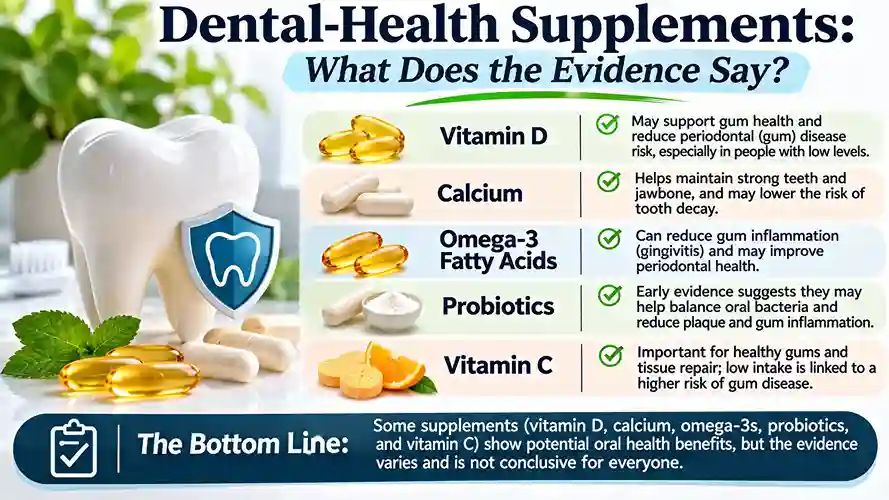
Dental health supplements occupy an unusual position: the mechanisms are plausible, several have been properly tested, and the results are more interesting than in most supplement categories — but the single most effective thing you can put in your mouth remains fluoride toothpaste. Here is what four of the most-studied ingredients actually did in trials.
Xylitol: famous, and narrower than you think
Xylitol is the headline ingredient in dental gums, mints and lozenges. The theory is sound — cavity-causing bacteria cannot ferment it into acid the way they ferment sugar, so it should starve them while still tasting sweet.
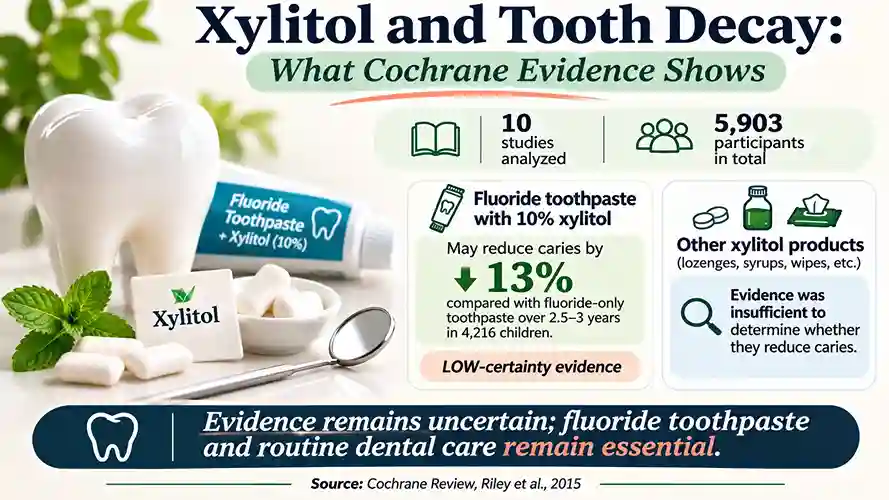
The definitive assessment is a Cochrane review covering 10 studies and 5,903 participants. Its conclusion was that evidence for xylitol in preventing cavities is limited. The quality assessment is worth sitting with: of those 10 studies, one was at low risk of bias and seven were at high risk.
One finding did survive. Over two and a half to three years, in 4,216 children, a fluoride toothpaste containing 10% xylitol reduced cavities by 13% compared with fluoride-only toothpaste — on low-quality evidence.
Note what that result is and is not. It is xylitol added to fluoride toothpaste, outperforming fluoride toothpaste alone by a modest margin. It is not xylitol gum, lozenges or tablets working on their own. For those products, the confidence intervals were compatible with both a reduction and an increase in cavities — which is the statistical way of saying nobody knows.
Oral probiotics: the most interesting evidence here
This is where the category gets genuinely promising. Rather than killing bacteria, oral probiotics attempt to colonise the mouth with strains that crowd out the harmful ones. Two strains of Streptococcus salivarius — K12 and M18 — have most of the dental research behind them.
A three-month double-blind placebo-controlled trial in 62 people with gingivitis found that M18 decreased both gingival bleeding and plaque accumulation. A separate four-week M18 trial reduced plaque scores with an effect size of 0.55 and improved gingival condition, with the gingival improvement persisting through a four-week follow-up while the placebo group showed no improvement on any measure.
K12 produced a narrower result: a pilot trial found no effect on saliva flow or salivary immunoglobulin A, but a significant reduction in plaque accumulation at four and six weeks.
The caveats are real. These are small trials — tens of participants, not thousands. They measure plaque and gum inflammation indices over weeks, not cavities or tooth loss over years. And the effect requires continued use, since the strains do not permanently colonise. But unlike most of what is sold for oral health, something measurable happened in properly controlled conditions.
Vitamin D: a strong association that supplementation did not deliver on
Vitamin D is the clearest illustration in dentistry of why association is not causation.
The observational link is solid. Meta-analyses find that people with periodontitis have lower serum vitamin D than people without it, and deficiency is widely described as a risk factor for gingivitis and periodontitis. The biological story is coherent too — vitamin D regulates immune response and bone metabolism, and periodontitis is an inflammatory disease that destroys the bone around teeth.
Then came the test. A 2026 systematic review and meta-analysis that included only randomised and controlled clinical trials — the highest tier of evidence — found that vitamin D supplementation provides no significant benefit as an adjunct to non-surgical periodontal therapy for either probing pocket depth or clinical attachment level, the two measures periodontists actually use.
Earlier reviews that pooled weaker study designs had reported improvements, and one systematic review described the relationship as linear while explicitly stating the evidence was insufficient. When the analysis was restricted to trials, the benefit did not hold.
That does not make vitamin D irrelevant. Correcting a genuine deficiency is worth doing for reasons that have nothing to do with your gums — see whether you need a vitamin D supplement. It means taking vitamin D expecting it to treat gum disease is not supported.
Vitamin C: real, unglamorous, and probably already handled
Vitamin C has the longest-established connection to oral health, because severe deficiency causes scurvy, whose signature symptoms are swollen, bleeding gums and loosening teeth. Collagen synthesis depends on vitamin C, and gum tissue is collagen-rich.
A systematic review found that vitamin C contributes to a reduced risk of periodontal disease. The practical question is whether supplementing adds anything if you are not deficient — and in a country where citrus, peppers and potatoes are abundant, frank vitamin C deficiency is uncommon. This is a nutrient to secure through diet rather than a supplement to buy for your gums.
What no dental supplement can do
Three limits apply regardless of ingredient:
- Nothing regrows enamel that is gone. Enamel has no living cells and cannot regenerate. Fluoride and remineralising agents can harden weakened enamel and reverse very early demineralisation; they cannot rebuild a cavity.
- Nothing reverses established periodontitis. Lost attachment and bone require professional treatment. Supplements are not an alternative to scaling and root planing.
- Nothing removes plaque mechanically. Plaque is a structured biofilm, and the only reliable way to remove it is physical disruption — brushing and cleaning between teeth.
Any product implying otherwise is making a claim the labelling rules do not permit it to make explicitly, which is why such claims arrive as suggestion rather than statement. Knowing how to read a supplement label is the practical defence.
What actually works
In rough order of evidence strength:
- Fluoride toothpaste, twice daily — the best-supported intervention in preventive dentistry, and the one everything else is measured against
- Cleaning between teeth daily, where brushes do not reach and gum disease typically starts
- Reducing the frequency of sugar intake — how often matters more than how much, since each exposure restarts the acid cycle
- Regular professional cleaning, which removes hardened deposits no home routine can
- Not smoking, which is among the strongest risk factors for periodontitis and impairs healing after treatment
Oral probiotics are a reasonable addition on top of that if you have persistent gum inflammation despite good hygiene, and are worth raising with your dentist. They are not a substitute for any item on the list.
The bottom line
Dental health supplements come out better than most categories, which says more about the others than about these. Oral probiotics have small but real trial evidence for reducing plaque and gum inflammation. Xylitol works best as an addition to fluoride toothpaste, with a 13% improvement on low-quality evidence, and little support as a standalone product. Vitamin D’s strong observational association did not translate into benefit when tested properly. Vitamin C matters, and your diet probably covers it.
Cavities affect up to 90% of children and most adults worldwide. That burden has been reduced enormously — by fluoride, brushing and professional care, none of which comes in a capsule.
Sources
- Xylitol-containing products for preventing dental caries in children and adults (Cochrane Oral Health)
- The effect of vitamin D supplementation on periodontal health: a systematic review and meta-analysis (Evidence-Based Dentistry, 2026)
- A three-month Streptococcus salivarius M18 supplementation decreases gingival bleeding and plaque accumulation: a randomized clinical trial
Frequently asked questions
Do dental health supplements work?
Some do, modestly. Oral probiotics containing Streptococcus salivarius M18 reduced gingival bleeding and plaque in randomised trials, and xylitol added to fluoride toothpaste reduced cavities by 13%. No supplement rebuilds enamel, reverses gum disease or replaces brushing.
Does xylitol prevent cavities?
The Cochrane review of 10 studies and 5,903 participants found limited evidence. The one positive result was fluoride toothpaste containing 10% xylitol outperforming fluoride-only toothpaste by 13% over three years. For xylitol gum, lozenges and tablets alone, the evidence could not distinguish benefit from harm.
Are oral probiotics good for gums?
Small randomised trials suggest yes. A three-month double-blind trial in 62 people with gingivitis found Streptococcus salivarius M18 reduced gingival bleeding and plaque accumulation, and a four-week trial improved gingival condition with a plaque effect size of 0.55.
Does vitamin D help gum disease?
People with periodontitis do have lower vitamin D levels, but a 2026 review restricted to randomised and controlled trials found supplementation gave no significant benefit alongside non-surgical periodontal treatment for pocket depth or attachment level.
Can supplements regrow tooth enamel?
No. Enamel contains no living cells and cannot regenerate. Fluoride and remineralising agents can harden weakened enamel and reverse very early damage, but nothing rebuilds an existing cavity.
