Men’s Health Supplements: What 52 Studies Actually Found

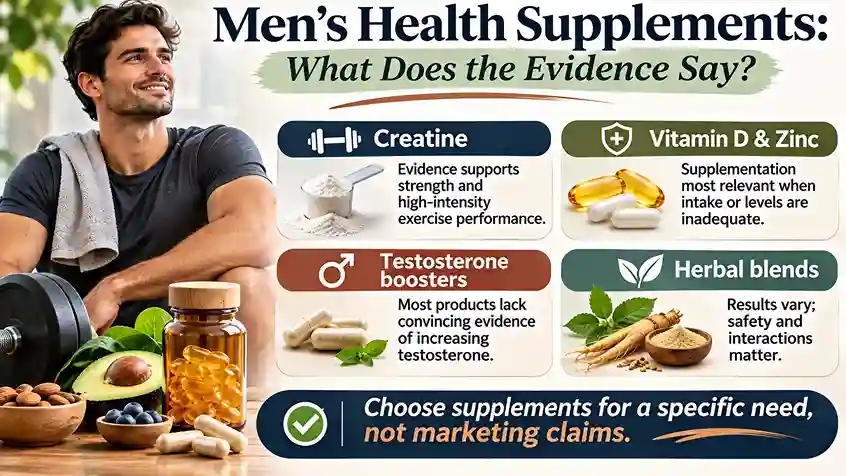
Men’s health supplements are dominated by two product categories — prostate formulas built around saw palmetto, and testosterone boosters. Both have been tested properly, and both came out the same way. A Cochrane review of 27 trials found saw palmetto provides little to no benefit, and a review of 52 studies across 27 booster ingredients found most do not raise testosterone at all.
Saw palmetto: the most-tested botanical in the category
Saw palmetto has more published randomised trial data behind it than any other herb sold for the prostate, which makes it unusually easy to assess. The results arrived in three stages.
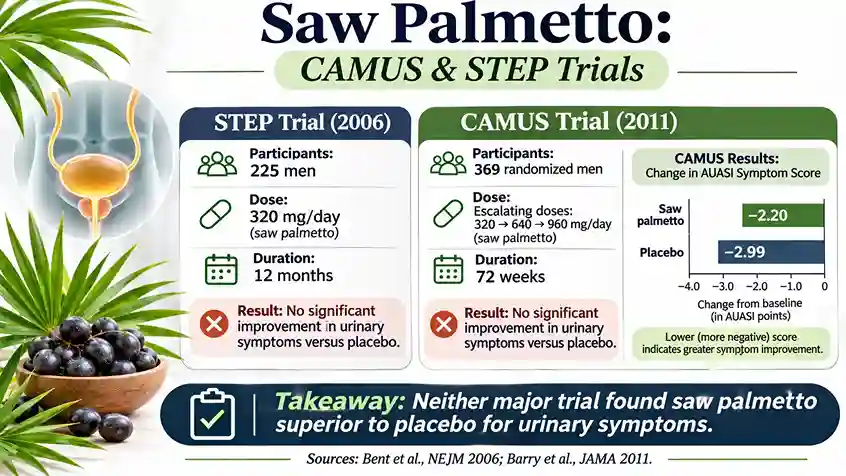
STEP (2006) gave 225 men the standard 320 mg daily dose for a full year. No benefit over placebo. CAMUS (2011) asked the obvious follow-up question — was the dose simply too low? It escalated 369 men through 320 mg, then 640 mg, then 960 mg daily over 72 weeks. No benefit at any dose.
The 2023 Cochrane review then pooled 27 randomised trials covering 4,656 men and concluded that saw palmetto alone provides little to no benefit for men with lower urinary tract symptoms due to benign prostatic enlargement. An earlier Cochrane review of 30 trials and 5,222 participants had already found it no more effective than placebo for symptom scores or peak urine flow.
Two things are worth saying in saw palmetto’s favour. CAMUS found no evidence of toxicity even at triple the standard dose, so this is a safe product rather than a dangerous one. And it had no significant effect on PSA at any dose, which means it is unlikely to interfere with PSA-based prostate cancer screening — a genuine concern with some other prostate products.
Why an enlarged prostate deserves a doctor, not a capsule
This matters more than the money wasted. Urinary symptoms in men over 50 are usually benign prostatic hyperplasia, but they can also signal prostate cancer, bladder problems or infection. Finasteride and tamsulosin have strong evidence and work through understood mechanisms.
Treating those symptoms with a supplement that three rigorous trials found ineffective means months or years of unmanaged symptoms, and a reason not to get examined. The evidence-based move is a doctor’s appointment first.
Testosterone boosters: the numbers behind the shelf
Testosterone boosters make a measurable claim, which makes them easy to test and hard to defend.
A 2023 systematic review pooled 52 studies covering 27 ingredients marketed as testosterone boosters. Its central finding was that most of them do not raise testosterone. A separate analysis of 50 popular retail products found that 90% claimed to boost testosterone while fewer than 25% had any published data supporting the claim — and for 61.5% of the ingredients involved, there was no data on testosterone at all.
The two signature ingredients both failed:
- Tribulus terrestris — a 2014 systematic review found no significant effect on testosterone in healthy men, and a 2025 review of ten studies found eight reported no significant change. Three decades of marketing has not produced a replicated positive result.
- D-aspartic acid — promoted on one short early study that later trials failed to repeat. A three-month placebo-controlled trial in resistance-trained men found no change in testosterone and no training benefit. A 14-day trial found the higher dose lowered total testosterone by around 12.5%.
What does work: correcting an actual shortfall
Zinc and vitamin D both appear in nearly every booster blend, and both have a real relationship with testosterone — in men who are deficient. Correct a genuine deficiency and levels can improve. Add them on top of adequate status and the expected effect is close to zero.
That distinction is the whole category in one sentence. These are nutrients, not hormones, and nutrients only help where something is missing. The way to know is a blood test, not a label — and if you are considering vitamin D, the current guidance on who actually needs it is worth reading first.
If you have symptoms of low testosterone — persistent fatigue, low libido, mood changes, loss of muscle — that is a medical question with a diagnostic test and real treatments behind it. Hypogonadism is a clinical diagnosis. No over-the-counter product treats it.
What actually moves the numbers
- Losing excess weight — body fat converts testosterone to oestradiol, and weight loss reliably raises testosterone in men with obesity
- Resistance training and adequate protein
- Sleeping seven hours or more — most daily testosterone release happens during sleep, and restriction measurably lowers it
- Limiting alcohol, which suppresses testicular function
- Getting screened — blood pressure, cholesterol, blood sugar and prostate checks on the schedule your doctor advises
The bottom line
Men’s health supplements have been tested unusually thoroughly, and the results are consistent. Saw palmetto is safe, does not interfere with PSA screening, and does not improve prostate symptoms — across 4,656 men, at triple the standard dose. Testosterone boosters mostly contain ingredients with no supporting data, and the two best known have repeatedly failed in trained men.
Where these products do something is in correcting a measured deficiency. Everything else on the label is a claim the trials have already answered.
Sources
- Serenoa repens for benign prostatic hyperplasia (Cochrane, 2023)
- Effect of increasing doses of saw palmetto extract on lower urinary tract symptoms: the CAMUS randomized trial (JAMA, 2011)
- The putative effects of D-aspartic acid on blood testosterone levels: a systematic review
Frequently asked questions
Does saw palmetto work for an enlarged prostate?
No. A 2023 Cochrane review of 27 trials and 4,656 men found little to no benefit, the STEP trial found none at 320 mg daily for a year, and CAMUS found none even at 960 mg daily over 72 weeks.
Do testosterone boosters work?
Mostly not. A 2023 review of 52 studies across 27 booster ingredients found most do not raise testosterone, and an analysis of 50 retail products found 90% made the claim while fewer than 25% had any supporting data.
Does tribulus raise testosterone?
No. A 2014 systematic review found no significant effect in healthy men, and a 2025 review of ten studies found eight reported no significant change despite three decades of marketing.
Does saw palmetto affect PSA tests?
No. Analysis of the CAMUS trial found no significant effect on serum PSA at any dose tested, up to three times the standard amount, so it is unlikely to interfere with prostate cancer screening.
Do zinc and vitamin D boost testosterone?
Only in men who are deficient. Correcting a measured shortfall can improve levels; adding them on top of adequate status has little expected effect.
Related articles
SodaPeak Reviews: It Has Caffeine and No Label
SodaPeak is a once-a-day gummy sold to men for energy, drive and stamina. This SodaPeak review looks at what the…
VigorHorse Reviews: 50 mg of Arginine, 1.5 g of Sugar
VigorHorse is a once-a-day gummy sold to men for drive, stamina and confidence. This VigorHorse review is built from the…
HoneyPower Reviews: 20 Ingredients, None of Them Honey
HoneyPower is a once-a-day capsule sold to men for drive, stamina and confidence. This HoneyPower review is built on the…