Lung Health Supplements: What the 3 Largest Trials Found

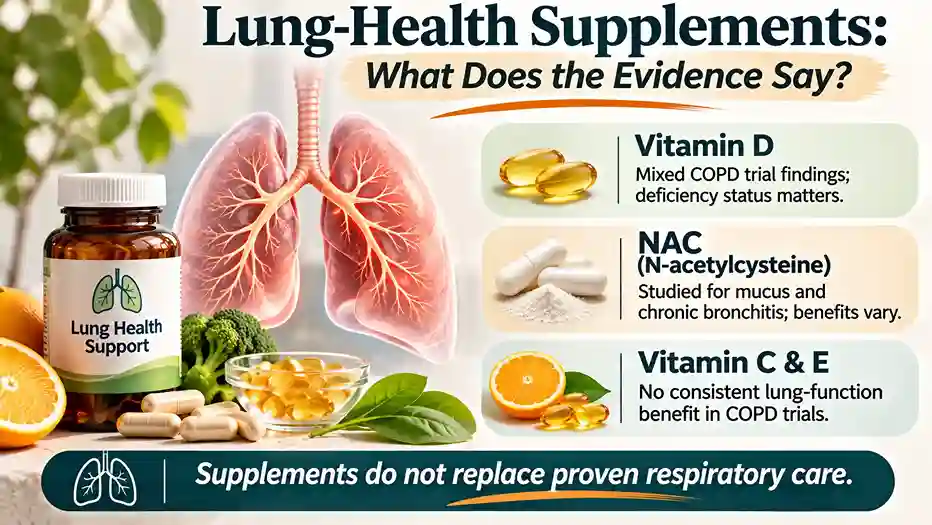
Lung health supplements are the one category where the evidence does not merely fail to support the marketing — in the largest trials ever run, the leading candidate made outcomes worse. Two studies involving more than 47,000 people found that beta-carotene supplements increased lung cancer in smokers. That result shaped how researchers think about antioxidants, and it is the first thing worth knowing before buying anything for your lungs.
The trial that reversed the advice
Through the 1980s, the case for beta-carotene looked strong. People who ate more carotenoid-rich fruit and vegetables consistently had lower rates of cancer, lung cancer in particular. Beta-carotene is the compound that makes carrots orange and is a potent antioxidant. Giving it to high-risk smokers in concentrated form seemed an obvious public health win, and two major trials were launched to prove it.
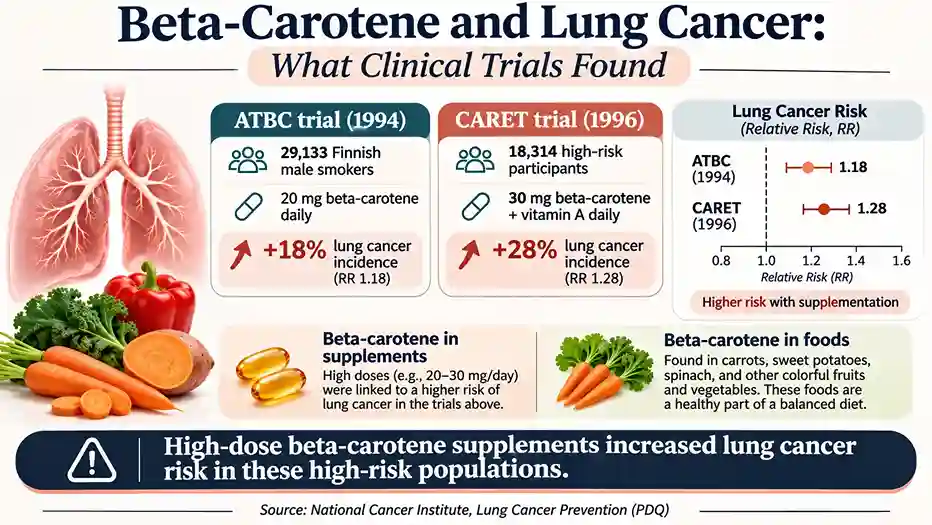
ATBC randomised 29,133 Finnish male smokers aged 50 to 69 to beta-carotene, alpha-tocopherol, both, or placebo. CARET randomised 18,314 smokers, former smokers and asbestos-exposed workers aged 45 to 74 to beta-carotene at 30 mg daily plus retinyl palmitate, or placebo.
Both trials were stopped early. In ATBC, the men taking 20 mg of beta-carotene daily had an 18% higher incidence of lung cancer and an 8% excess in overall mortality. CARET found a similar picture, with a 28% increase. Across more than 47,000 participants, the finding was consistent: pharmacological doses of beta-carotene did not prevent lung cancer in high-risk people. They promoted it.
The World Health Organization’s expert committee on food additives subsequently withdrew its acceptable daily intake figures for beta-carotene, citing the elevated lung cancer risk seen in these two trials.
Why the observational data misled everyone
This is the clearest lesson in the supplement literature, and it generalises far beyond beta-carotene.
People who eat plenty of vegetables differ from people who don’t in dozens of ways — they smoke less, exercise more, drink less, have more money and see doctors more often. An observational study can adjust for some of those factors, never all of them. The carotene in their blood was a marker of a whole pattern of living, not the active ingredient in it.
Isolating one molecule from that pattern and administering it at 20 to 30 times dietary levels produced something different from eating carrots. In damaged, inflamed lung tissue exposed to decades of cigarette smoke, the high-dose compound appears to have behaved in ways nobody predicted from the epidemiology.
Two boundaries are worth noting, because they matter practically. Risk was not increased in moderate smokers of under a pack a day in ATBC, nor in former smokers in CARET. And heavy smokers taking under 15 mg of beta-carotene a day are not expected to face increased risk — which places ordinary multivitamin levels and dietary intake outside the concern. The problem was high-dose isolated supplementation in people actively smoking heavily.
N-acetylcysteine: the one with real support
NAC is the exception in this category, and it has been studied properly in people with established disease rather than healthy adults.
A meta-analysis of 13 studies covering 4,155 COPD patients found that those taking NAC had significantly and consistently fewer exacerbations, a 25% risk reduction. A more recent systematic review put the figure at 13% overall — and found something counterintuitive in the subgroup analysis: low-dose NAC at 600 mg a day or less reduced exacerbations, while higher doses showed no clear benefit.
The limits are as important as the finding. The same review found no clear benefit for lung function, quality of life or glutathione levels — NAC appears to reduce flare-ups without improving how well the lungs work. And a two-year randomised trial of 968 patients with mild-to-moderate COPD taking 600 mg twice daily found no significant reduction in total exacerbations and no improvement in lung function, though moderate-to-severe exacerbations were 24% lower.
A 2026 expert consensus landed on NAC as a useful adjunct in COPD, particularly in chronic bronchitis phenotypes, for preventing exacerbations. Note the framing: an adjunct to treatment for a diagnosed condition, prescribed alongside inhalers — not a supplement for healthy lungs.
Vitamin D: only if you are deficient
Vitamin D has been tested for both COPD and asthma exacerbations, and the results follow a pattern that appears throughout nutrition research.
A meta-analysis of individual participant data found that supplementation did not influence the overall rate of moderate or severe COPD exacerbations. But in the subgroup starting with blood levels below 25 nmol/L — severe deficiency — it safely and substantially reduced them. Above that level, nothing.
Asthma showed the same shape. Across seven trials and 955 participants, vitamin D reduced exacerbations requiring systemic corticosteroids among those with baseline levels under 25 nmol/L, with no comparable effect in people who were already replete.
This is correction of a deficiency, not enhancement of normal function — the same distinction that runs through the wider evidence on whether you need a vitamin D supplement. If you have COPD or asthma, this is a conversation for your doctor, who can test rather than guess.
What is sold without evidence
Much of what is marketed for lung health — “lung cleanse” blends, respiratory herbal formulas, detox protocols — has not been tested in randomised trials for the outcomes the labels imply. Absence of evidence is not proof of harm, but it does mean the claims are assertions rather than findings.
Two specific cautions follow from the trials above. First, be wary of high-dose isolated antioxidants, which is precisely what failed. Second, multi-ingredient blends make it impossible to know what you are taking or at what dose — and the label is where to start checking, as covered in how to read a supplement label.
What actually protects lung function
The interventions with real evidence behind them are not supplements:
- Stopping smoking — the single largest modifiable factor, at any age and after any duration
- Testing your home for radon — the leading cause of lung cancer in people who never smoked
- Vaccination against influenza, pneumococcus, COVID-19 and RSV where indicated, since infections drive exacerbations and permanent decline
- Aerobic exercise, which does not increase lung capacity but improves how efficiently you use it
- Reducing indoor air pollution — ventilation when cooking, avoiding wood smoke, filtration during wildfire season
- Eating the vegetables, which is what the observational data actually supported all along
The bottom line
Lung health supplements are the category where the gap between marketing and evidence is widest, and where the consequences of getting it wrong have been measured. Beta-carotene is the cautionary tale: a plausible mechanism, strong observational support, enormous enthusiasm, and 47,000 participants later, more lung cancer and more deaths.
NAC has genuine support as an adjunct for COPD exacerbations, at modest doses, in people with diagnosed disease. Vitamin D helps if you are severely deficient. For healthy lungs, there is no supplement with evidence that it does anything — and one with evidence that it did harm.
Sources
- National Cancer Institute — Lung Cancer Prevention (PDQ)
- Vitamin D to prevent exacerbations of COPD: IPD meta-analysis (Thorax)
- The efficacy of N-acetylcysteine in the management of COPD: systematic review and meta-analysis (PeerJ, 2026)
Frequently asked questions
Do lung health supplements work?
For healthy lungs, no supplement has good evidence of benefit. N-acetylcysteine has support as an adjunct for reducing exacerbations in diagnosed COPD, and vitamin D helps people who are severely deficient, but neither improves lung function in healthy adults.
Is beta-carotene bad for your lungs?
High-dose beta-carotene supplements increased lung cancer incidence by 18% and overall mortality by 8% in heavy smokers in the ATBC trial, with similar findings in CARET. Risk was not increased in moderate smokers or former smokers, and dietary levels are not a concern.
Does NAC help COPD?
A meta-analysis of 13 studies and 4,155 patients found NAC reduced COPD exacerbations by about 25%. Low doses of 600 mg a day or less showed benefit while higher doses did not, and NAC does not appear to improve lung function or quality of life.
Should I take vitamin D for asthma or COPD?
Only if you are deficient. Supplementation did not reduce exacerbations overall in either condition, but did help people starting with blood levels below 25 nmol/L. Ask your doctor to test rather than supplementing on assumption.
What actually improves lung health?
Stopping smoking, testing for radon, staying current on respiratory vaccinations, aerobic exercise, reducing indoor air pollution, and eating a diet high in vegetables — all of which have stronger evidence than any supplement sold for lung health.
Related articles
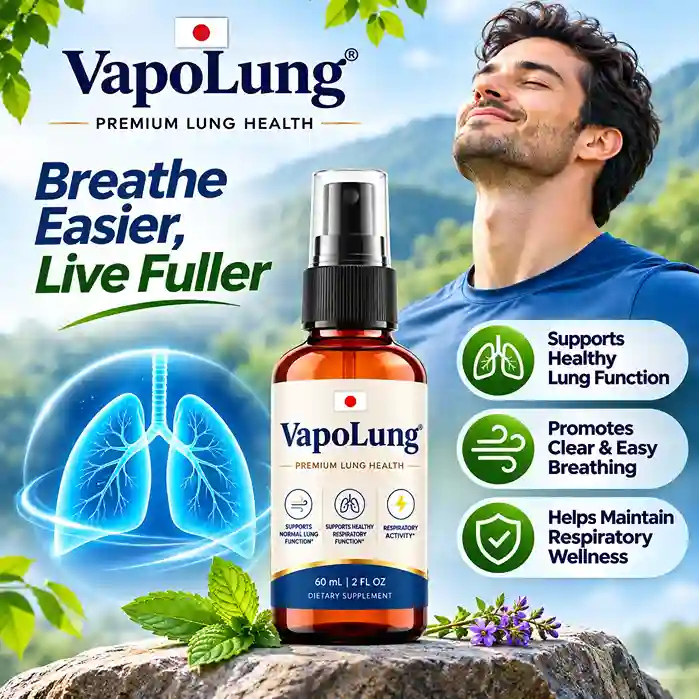
VapoLung Review: Scam or Legit? 3 Ingredients Checked
VapoLung is a spray you use in your mouth, sold to clear congestion and improve how you breathe. This VapoLung…

BreathiZen Review: An Honest Look at All 5 Ingredients
Short of breath, chesty, or feel like you can’t fill your lungs properly? You want it fixed. This BreathiZen review…