HoneyPower Reviews: 20 Ingredients, None of Them Honey

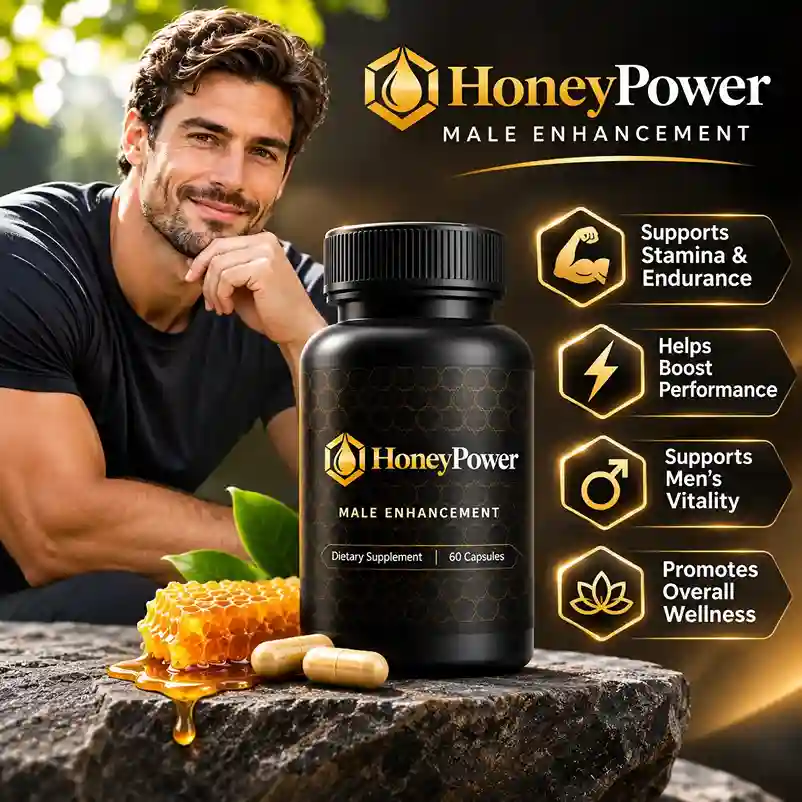
HoneyPower is a once-a-day capsule sold to men for drive, stamina and confidence. This HoneyPower review is built on the actual Supplement Facts panel, not the sales page.
Two things you should know before anything else. There’s no honey in it. And the label tells a very different story from the marketing.
This article contains affiliate links. If you buy through one, we may earn a commission at no extra cost to you. How this works
What is HoneyPower?
HoneyPower is a capsule you take once a day, with a glass of water, 20 to 30 minutes before a meal. A bottle holds 30 capsules, so one bottle is one month.
The label calls it “Male Enhancement.” The sales page is careful to say it isn’t a treatment for erectile dysfunction and isn’t a substitute for prescribed medication.
Despite the name, honey isn’t in the formula. We read the full Supplement Facts panel and there’s no honey, no royal jelly, no propolis and no bee product of any kind.
What’s in there instead is 20 separate ingredients, which is where this HoneyPower review gets interesting.
See the official page and current pricing
Why men try it
The pitch is aimed at men over 30 who’ve noticed their energy and drive aren’t what they were. That’s a real and common experience, and it’s awkward to raise with anyone.
A capsule you take with breakfast asks nothing of you. No appointment, no conversation, no explaining.
The page is also more measured than most in this category. It names no doctors, invents no testimonials and explicitly says it won’t treat erectile dysfunction.
So we went in expecting better than usual. Then we read the label.
How to take HoneyPower
One capsule daily with 8 oz of water, ideally 20 to 30 minutes before eating.
The page suggests some men notice changes in one to two weeks, that two of the botanicals need four to six weeks, and that 60 to 90 days gives fuller benefits.
That’s a more honest timeline than the “results in days” claims we usually see. Herbal ingredients genuinely do take weeks.
The catch is that the 60-day refund window closes right as the 60-to-90-day timeline begins.
What’s actually in HoneyPower

Unlike most products we cover, HoneyPower publishes a real Supplement Facts panel. We read it off the label for this HoneyPower review. Here’s what it says per capsule:
| Ingredient | Amount |
|---|---|
| Calcium (as calcium carbonate) | 184 mg |
| Zinc (as zinc oxide) | 25 mg |
| Longjack / Tongkat Ali (root) | 200 mg |
| Maca (root) | 125 mg |
| L-Arginine HCl | 125 mg |
| Ginseng & Eleuthero blend | 63 mg |
| Proprietary blend of 13 more | 373 mg total |
That’s about 1,095 mg in one capsule. Now look at what those numbers mean.
The arginine is the problem
L-arginine is a genuinely useful ingredient for circulation. The research is clear about how much you need.
The most-cited trial gave men 5,000 mg a day for six weeks. Another used 6,000 mg daily for three months.
And critically: a placebo-controlled trial at 1,500 mg a day found no effect at all. There’s a documented floor below which it simply doesn’t do anything.
HoneyPower contains 125 mg. That’s one-fortieth of the dose that worked, and one-twelfth of the dose that already failed.
It’s also the HCl form, so the actual arginine content is lower still — around 103 mg.
The maca is the same story
Maca studies use 1,500 to 3,000 mg daily. The capsule has 125 mg, somewhere between a twelfth and a twenty-fourth of that.
The proprietary blend
Thirteen ingredients share 373 mg between them. That averages about 29 mg each, and the label doesn’t say how it’s divided.
Among those thirteen is Muira Puama, which the page features as a headline botanical. The two small French studies behind its reputation used 1 to 1.5 grams a day — that’s 1,000 to 1,500 mg.
The entire blend is 373 mg. One of its thirteen ingredients needs four times the whole blend to match its own research.
Also in there: tribulus, typically studied at 750 mg and up, and catuaba and oat straw, neither of which has meaningful human evidence for this purpose.
The one that’s dosed correctly
Credit where it’s due. Longjack, better known as Tongkat Ali, is at 200 mg — which is exactly the dose used in the trials that raised testosterone in men who started out low.
One caveat. Those trials used a standardised extract, meaning it’s processed so each dose contains a known amount of the active compounds. The label just says “root,” with no standardisation stated.
Still, it’s the right number, and that’s more than most products in this category manage.
Check the label on the official page
Three things on the label that don’t match the page
These are the kind of details you only catch by reading the panel itself.
It isn’t plant-based
The page displays a “100% Plant-Based” badge. The proprietary blend contains Orchic (substance) — which is cattle testicle tissue — and Oyster Extract.
The label’s own allergen line reads: contains shellfish (oyster). A product can’t be 100% plant-based and carry a shellfish warning.
On orchic specifically: a review of 50 testosterone-boosting supplements found no published data supporting testicle extract for testosterone. Most products in that analysis had no ingredient with a plausible mechanism at all.
Cattle testicle tissue contains only trace amounts of testosterone, and no human trial has measured what it does to testosterone levels.
The nettle is the wrong part of the plant
Nettle appears for prostate support. The label specifies nettle leaf.
All the prostate research is on nettle root. Leaf and root are studied for completely different things — leaf for hay fever and inflammation, root for urinary symptoms.
The biggest single ingredient is chalk
Set aside the proprietary blend and the largest measured ingredient is calcium carbonate at 184 mg. There’s more chalk in this capsule than arginine, and more chalk than maca.
Calcium carbonate is a cheap bulking agent. In a men’s performance capsule it isn’t doing anything for performance — it’s filling space.
Worth noting on the zinc too: at 25 mg it’s 228% of the daily value, and it’s zinc oxide, the least well-absorbed of the common forms.
Does HoneyPower work?

Probably not, and now we can say why with actual numbers rather than guesswork.
One ingredient out of twenty is at its studied dose. The arginine is at 2.5% of the trial dose and the maca is under 10%.
The thirteen-ingredient blend is smaller than what a single one of those thirteen needs on its own. That’s the core finding of this HoneyPower review.
Compare these numbers against the official page
This is what’s often called a kitchen-sink formula. Twenty names on the label looks impressive and lets the page talk about circulation, hormones, stamina and prostate all at once.
But the capsule is a fixed size. Every ingredient you add makes every other ingredient smaller. Twenty names in one capsule guarantees that almost nothing reaches a working amount.
A formula with three ingredients at full doses would outperform this one comfortably.
Please read this before you buy
If your drive or performance has genuinely changed, that’s worth a conversation with a doctor rather than a capsule.
The blood vessels involved are small, so changes there often show up before problems elsewhere do. New erection difficulty can be an early signal of heart disease, diabetes or blood pressure problems.
Low testosterone with a treatable cause is also real, and a blood test settles it in a way no supplement can.
The page itself says it isn’t a treatment for erectile dysfunction. Take that at its word.
What works better
- Buy the ingredients that work, separately. Standardised Tongkat Ali at 200 mg and L-arginine at 3 to 5 grams are both sold on their own, with the amount printed on the tub. You’d get 40 times the arginine for a fraction of $89.
- L-citrulline instead of arginine. It raises arginine levels in the body more reliably than arginine itself, at 2 to 3 grams a day.
- Exercise. In the Tongkat Ali trial that improved erectile function, the men were also training three times a week. The exercise was part of the result.
- Sleep and alcohol. Both move testosterone and performance more than any capsule, and neither costs anything.
If the cause turns out to be medical, treating the cause beats all of the above.
HoneyPower reviews and complaints
Searching for a HoneyPower review turns up mostly affiliate pages. There’s no Amazon listing, no retail shelf and no verified-buyer record we could find for this product.
The page carries no testimonials at all — no names, no photos, no before-and-afters. That’s unusual, and we’d rather see none than invented ones.
It also names no doctors and no experts. Again, better than fabricating them.
The one statistic it does use is “Join 94% of Customers Who Choose the 6-Bottle Pack.” No source or method is given, and it isn’t really a claim about the product — it’s a nudge toward the biggest order.
The reference list
HoneyPower lists 12 references with PubMed IDs, which is better sourcing than most. It also displays PubMed, NIH and NEJM logos, with a disclaimer that it isn’t affiliated with them.
The problem is what the references actually cover:
- The pumpkin seed study looked at urinary symptoms from an enlarged prostate, not performance.
- The oat extract studies measured blood vessel function and thinking skills in older adults, not anything sexual.
- One reference tests an entirely different product.
- The sarsaparilla references cite Smilax species that may not match the one on the label, which is Chinese sarsaparilla.
And as the page itself concedes elsewhere, research on individual ingredients doesn’t show that a finished blend does anything.
Read the company’s claims and references
Is HoneyPower safe?
Nothing in this HoneyPower review points to a serious safety problem. At these amounts most ingredients are too small to do much either way.
The page deserves credit for listing interaction warnings, which many don’t. The real points to watch:
- Shellfish allergy — this contains oyster extract. The allergen warning is on the label, not on the sales page’s plant-based badge.
- Nitrates for chest pain, where anything affecting blood flow matters.
- Blood pressure or blood-thinning medication.
- 25 mg of zinc daily is well above the daily value. Taken long-term, zinc at this level can interfere with copper absorption.
- Liquorice is in the blend, and at real doses it can raise blood pressure. The amount here is likely tiny, but mention it to your doctor if yours is high.
- Orchic extract is animal tissue, and there’s a general caution about animal-glandular products and sourcing.
HoneyPower price
| Package | Per bottle | Total | Page’s “regular” | Shipping |
|---|---|---|---|---|
| 1 bottle (30 days) | $89 | $89 | $99 | + shipping |
| 3 bottles (90 days) | $59 | $177 | $447 | + shipping |
| 6 bottles (180 days) | $49 | $294 | $894 | Free USA |
The totals all multiply correctly and the savings figures match their own reference prices. But two things don’t add up.
The reference price changes. The multi-bottle tiers are priced against $149 a bottle. The single bottle is priced against $99. Same product, two different “regular” prices on one page.
“SAVE 75%” doesn’t match anything. The best discount is $49 against $149, which is 67%. Against $99 it’s 51%. Neither is 75%.
There’s also a shipping contradiction: the page promises free USA shipping in several places, while the 1-bottle and 3-bottle cards both say “+ Shipping.”
At $89 plus shipping, a single bottle is about $3 a day — and it’s only $10 off its own reference price, which makes it the worst value on the page by a wide margin.
Genuine positive: the page states there are no subscriptions and no recurring charges. One-time purchase only.
The guarantee
A 60-day money-back guarantee, with the FAQ promising a full refund no questions asked.
There’s a real support email and a US phone number listed, plus a mailing address in Ogden, Utah — though it’s a PO Box rather than a facility.
One oddity: the support email is on a different domain from the product site. That isn’t sinister on its own, but note it down before you need it.
The timing problem is the one to plan for. The page says 60 to 90 days for fuller benefits, and the refund window is 60 days.
So decide by around day 50, while you can still act on it.
Check the current guarantee terms
Our verdict
HoneyPower does several things better than most products we cover. It publishes a real Supplement Facts panel with actual amounts, and invents no testimonials and no doctors.
It also sources its references with PubMed IDs, admits it won’t treat erectile dysfunction, and runs no subscription trap.
And the panel it honestly published is what sinks it.
The arginine sits at 2.5% of the trial dose, below a level already shown to do nothing. Maca is under a tenth.
Thirteen ingredients share 373 mg, and one of them needs four times that on its own. The biggest measured ingredient is chalk.
Then there are the mismatches: a plant-based badge on a product containing cattle and shellfish tissue, nettle leaf where the research used root, and a 75% saving that doesn’t compute.
One ingredient out of twenty is correctly dosed. You can buy that one on its own.
What to do next
- If something has genuinely changed, see a doctor. A blood test and a blood pressure check answer questions no capsule can.
- If you want the ingredient that’s dosed right, buy standardised Tongkat Ali at 200 mg, with the amount on the label.
- If you want the circulation effect, buy L-citrulline or arginine properly dosed — grams, not 125 mg.
- Skip the single bottle. At $89 plus shipping for $10 off, it’s the worst-value option on the page.
- If you buy anyway, set a reminder for day 50 and claim the refund then, because the stated benefit timeline runs past the refund window.
Does HoneyPower contain honey?
No. We read the full Supplement Facts panel and there’s no honey, royal jelly, propolis or any bee product in it. It’s a 20-ingredient botanical and mineral capsule.
Does HoneyPower really work?
Unlikely at these amounts. The label shows 125 mg of L-arginine, where the main trials used 5,000 mg and a trial at 1,500 mg found no effect at all. Maca is at 125 mg against a studied 1,500 to 3,000 mg.
What are the HoneyPower ingredients?
Per capsule: calcium 184 mg, zinc 25 mg, longjack 200 mg, maca 125 mg, L-arginine HCl 125 mg, a ginseng and eleuthero blend 63 mg, and a 373 mg proprietary blend of 13 more including muira puama, tribulus, orchic and oyster extract.
Is HoneyPower plant-based?
No, despite the badge on the sales page. The blend contains orchic substance, which is cattle testicle tissue, and oyster extract. The label’s own allergen line says it contains shellfish.
Is anything in it dosed correctly?
Yes, one thing. Longjack, also called Tongkat Ali, is at 200 mg, which matches the dose used in trials that raised testosterone in men who started low. The trials used a standardised extract though, and the label doesn’t state standardisation.
Is HoneyPower legit?
It’s a real product with a published label, a support email, a US phone number and no subscription. But the sales page carries a plant-based badge it contradicts, a “SAVE 75%” that computes to 67%, and two different regular prices for the same bottle.
Is HoneyPower safe?
Most ingredients are too small to do much either way. Avoid it if you have a shellfish allergy, and check with a doctor if you take nitrates, blood pressure medication or blood thinners. The 25 mg of zinc is 228% of the daily value, which can affect copper absorption long-term.
Where this came from
Ingredient amounts come from the product’s own Supplement Facts panel; pricing and claims from the sales page, checked on 22 November 2026. Here’s the research behind this HoneyPower review.
- Long-term high-dose L-arginine in vasculogenic erectile dysfunction — the 6 g/day trial
- A multifaceted approach to maximize erectile function and vascular health — 5 g works, 1.5 g showed no effect
- Drugs.com — Muira puama clinical overview — the 1 to 1.5 g daily dose, and the lack of controlled trials
- Standardised Tongkat Ali extract in men with late-onset low testosterone — the 200 mg dose
- RxList — Orchic extract — no evidence it provides testosterone
- Drugs.com — Nettle clinical overview — the prostate research is on root, not leaf
Related articles
SodaPeak Reviews: It Has Caffeine and No Label
SodaPeak is a once-a-day gummy sold to men for energy, drive and stamina. This SodaPeak review looks at what the…
VigorHorse Reviews: 50 mg of Arginine, 1.5 g of Sugar
VigorHorse is a once-a-day gummy sold to men for drive, stamina and confidence. This VigorHorse review is built from the…
AlphaFuel Pro Reviews: 6 Botanicals, No Amounts Listed
AlphaFuel Pro is a six-herb capsule sold to men for erection problems and low testosterone. This AlphaFuel Pro review checks…